
Finance jobs are not disappearing overnight. But the work inside them is changing fast.
A few years ago, the fear sounded dramatic. AI would sweep through finance, replace analysts, shrink accounting teams, and turn large parts of white-collar work into software. That story was always a little too neat.
What is happening now is more interesting.
AI is not walking into finance and deleting entire departments in one move. It is quietly reshaping the daily work inside them. The spreadsheet still exists. The month-end close still exists. The forecast deck still exists. The risk memo still exists. But the way those things get produced is changing faster than many finance professionals expected.
That distinction matters.
The real question is no longer just “Will AI replace finance jobs?”
The better question is “Which parts of finance work are becoming automated, and which parts are becoming more valuable because AI exists?”
That is where the real future of finance careers is being decided.
Why finance is such an easy target for AI
Finance has always been one of the most structured parts of the economy. It runs on numbers, documents, policies, reconciliations, classifications, approvals, and repeatable workflows. In other words, finance produces exactly the kind of environment AI likes most: lots of patterns, lots of rules, and lots of recurring tasks.
That does not mean finance is easy. It means parts of finance are highly standardizable.
If a job involves pulling numbers from different systems, cleaning them, formatting them, summarizing them, and packaging them into the same report every week or every month, AI will naturally move closer to that work. If a job depends on first-draft writing, standard commentary, transaction tagging, policy lookup, or exception flagging, AI will almost certainly become part of that workflow.
That is why finance feels exposed.
But exposure is not the same as extinction.
The biggest mistake people make when they think about AI and finance jobs
People often imagine jobs as fixed boxes. Accountant. Analyst. Controller. Compliance officer. Risk manager. Auditor.
AI does not see jobs that way.
AI sees workflows.
That is why entire job titles may survive while the work inside them changes dramatically. A financial analyst may still be called a financial analyst, but may spend less time building a first draft of a model and more time pressure-testing assumptions. An accountant may still own the close process, but spend less time matching transactions manually and more time reviewing anomalies. A compliance professional may still monitor activity, but the job may shift from scanning everything to deciding what actually matters.
The job title stays.
The center of gravity moves.
That is the real story.
What AI is most likely to automate in finance
Some tasks are simply more vulnerable than others. Usually, they share three traits: they are repetitive, structured, and easy to standardize.
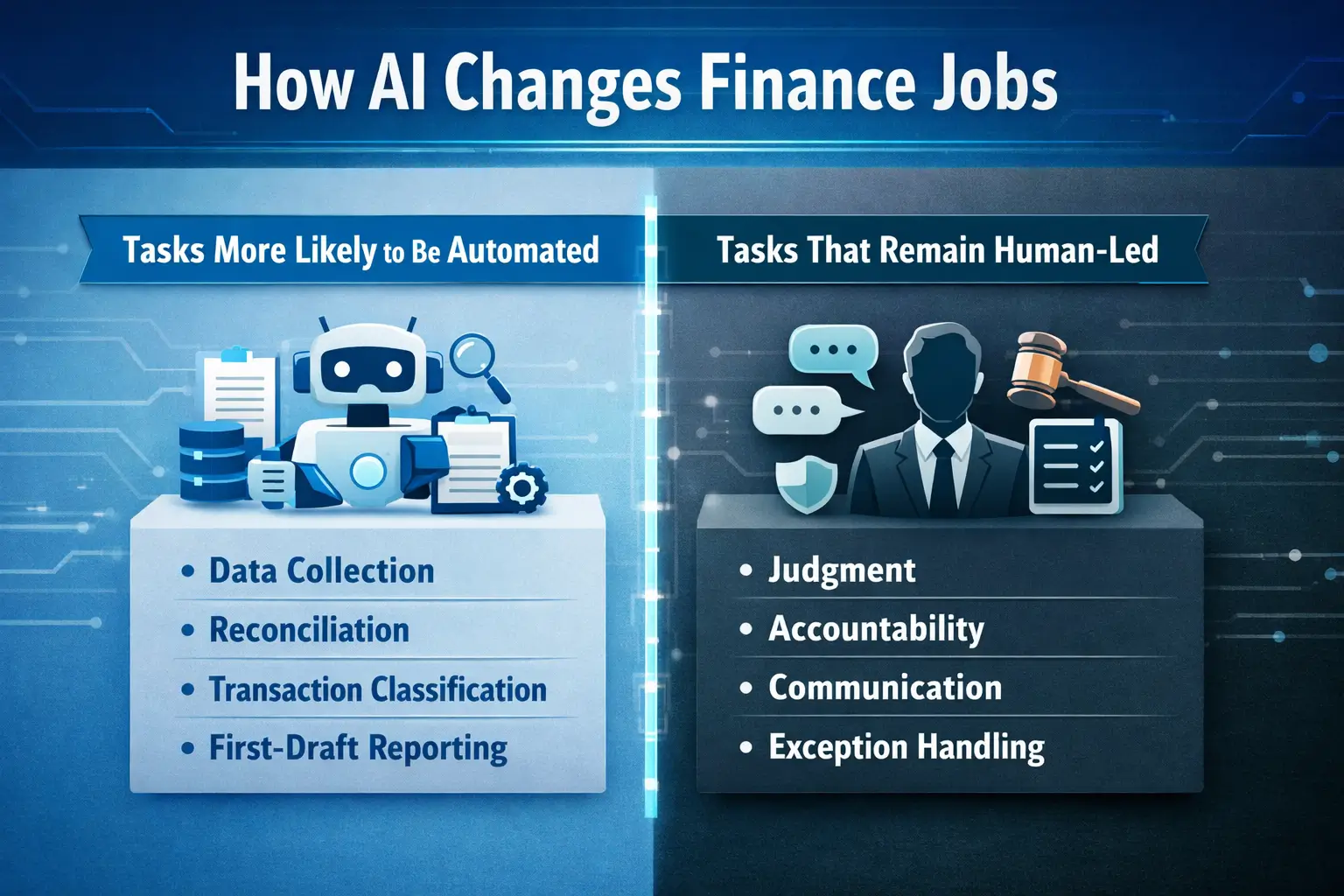
Tasks more likely to be automated
- Data collection from multiple systems
- Spreadsheet cleanup and formatting
- Routine reconciliations
- First-draft reporting
- Basic financial commentary
- Transaction classification
- Policy lookup
- Standard customer or internal responses
- Document extraction and summarization
- Exception flagging
These are important tasks, but they are not usually the final layer of value. They are often the preparation layer.
AI is getting better at preparation work.
What finance professionals will still do that AI cannot fully own
The deeper you go into uncertainty, accountability, and human judgment, the less simple the automation story becomes.
Tasks less likely to be fully replaced
- Making decisions when the data is incomplete
- Interpreting ambiguous regulations
- Explaining trade-offs to executives
- Handling unusual exceptions
- Owning a control failure
- Speaking with clients during uncertainty
- Challenging assumptions in planning or valuation
- Deciding whether an output is “technically correct” but commercially wrong
- Taking responsibility when a model makes a bad recommendation
These are not just “soft skills.” In finance, they are often the highest-value skills.
A simple way to think about it
| Area of finance work | What AI can do well | What humans still need to do |
|---|---|---|
| Accounting | Match, classify, summarize, flag | Review, interpret, approve, explain |
| FP&A | Draft scenarios, summarize trends, automate reporting | Challenge assumptions, align stakeholders, tell the story |
| Risk | Detect anomalies, monitor patterns, surface alerts | Decide materiality, escalate, own the judgment |
| Compliance | Search policies, review large volumes, identify signals | Interpret rules, manage edge cases, defend decisions |
| Audit | Extract evidence, compare records, spot inconsistencies | Assess significance, question context, form conclusions |
| Treasury | Track flows, support forecasting, automate dashboards | Make strategic liquidity decisions, manage uncertainty |
The table tells the whole story in one line: AI handles more of the first pass, while humans remain responsible for the final call.
What happens to accountants?
This is one of the most searched versions of the question for a reason. Many people assume accountants are at the front of the AI wave because accounting includes routine, rules-based work.
That is partly true.
If someone’s value is mostly manual processing, repetitive documentation, or low-level transaction handling, the pressure will increase. But accounting is much larger than processing. Accounting also includes judgment, policy interpretation, internal control design, audit readiness, and explaining what the numbers actually mean.
That is why the future of accounting probably splits into two paths.
The first path gets cheaper and more automated.
The second path becomes more advisory, more control-oriented, and more strategic.
The accountant who only moves numbers may feel more pressure.
The accountant who understands systems, controls, risk, and communication may become more valuable.
What happens to financial analysts?
Analysts are not disappearing either. But the easy parts of analysis are becoming less defensible.
If an analyst mostly gathers data, updates recurring charts, writes predictable commentary, and repackages standard trends, AI will increasingly sit in that space. If an analyst can connect business drivers, explain why a forecast changed, challenge a sales assumption, or translate numbers into action, that is much harder to replace.
In other words, the analyst of the future may spend less time producing analysis and more time defending insight.
That is a more demanding role, but also a more valuable one.
What happens to entry-level finance jobs?
A lot of entry-level finance work has traditionally been built around the exact tasks AI can now support: gathering data, cleaning files, preparing summaries, doing first-pass checks, and updating templates. That does not mean junior roles vanish entirely, but it does mean the old learning ladder may change.
Some firms may hire fewer people to do basic repetition. Others may still hire juniors, but expect them to work with AI from day one and contribute at a higher level much faster.
That creates a new challenge: how do people build judgment if the low-level work disappears too quickly?
This may become one of the biggest talent questions in finance over the next few years. Companies still need future controllers, CFOs, audit leaders, and risk heads. But if the old apprenticeship layer gets thinner, firms will need to redesign how finance talent is trained.
The future of finance jobs will belong to people who can do three things
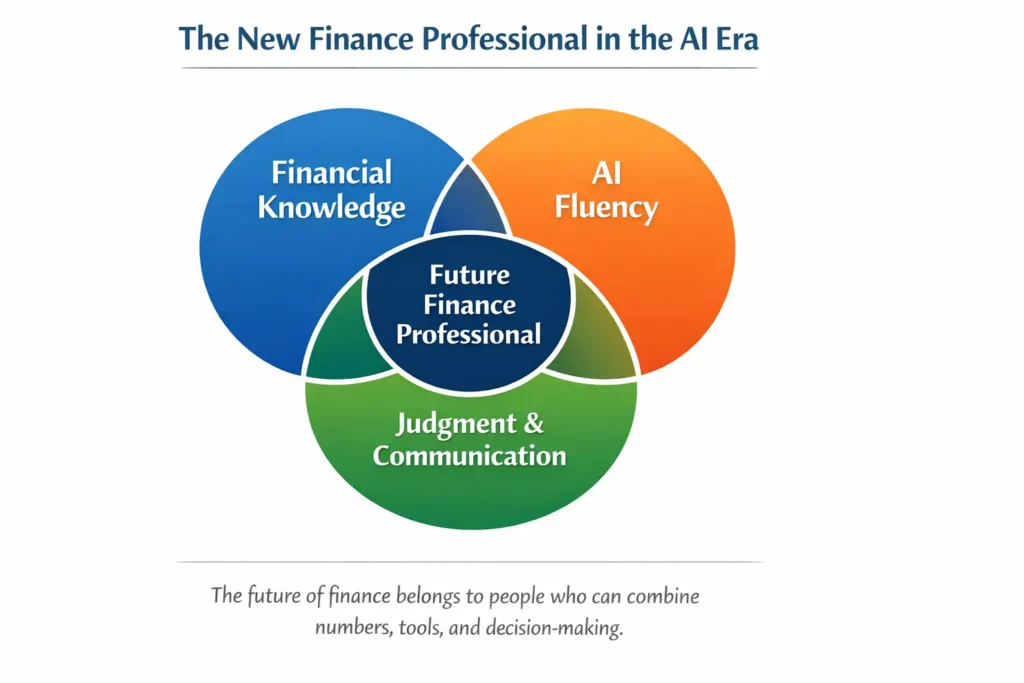
The strongest finance professionals in the AI era will probably be the ones who combine three abilities.
1. Understand the numbers
This still matters. Finance without technical depth is just opinion with formatting.
2. Use AI without trusting it blindly
The best professionals will know how to prompt, review, compare, test, and question outputs. They will use AI as leverage, not as a replacement for thinking.
3. Make judgment visible
In a world where anyone can generate a clean summary, the real value shifts toward explaining what matters, what is risky, what is missing, and what decision should be made next.
That combination is powerful.
A weak finance worker may become easier to replace.
A strong finance worker may become dramatically more productive.
So, will AI replace finance jobs or change them?
It will change them first. And for many roles, that change will be bigger than people expect.
Some positions will shrink. Some teams will get leaner. Some tasks that once took days will take minutes. Some skills that once looked impressive will become basic expectations. But finance itself is not fading away. If anything, it is becoming more important because companies now need people who can understand both numbers and systems, both automation and accountability.
That is why the future does not belong to the finance professional who resists AI as if it were a passing trend.
It belongs to the one who knows where AI is useful, where it is dangerous, and where a human being still has to take the wheel.
The real career risk is not AI
The real career risk is staying stuck in low-context, repeatable work for too long.
That was already risky before AI. It is simply more visible now.
Finance professionals who move toward interpretation, controls, governance, business partnering, strategic analysis, and decision support are moving toward the parts of the field that become more valuable when automation grows.
That is the twist many people miss.
AI may reduce some finance work.
But it may also increase the value of better finance work.
And that is a very different story from simple replacement.
Final thoughts
If you work in finance, this is probably the wrong moment to panic and the right moment to upgrade.
Learn the tools.
Understand the workflow.
Question the output.
Improve your writing.
Sharpen your judgment.
Know the business better than the model does.
Because the future of finance jobs will not be decided by who can do everything manually.
It will be decided by who can combine financial knowledge, technological fluency, and trusted judgment in the same role.
