
Global Payment Map
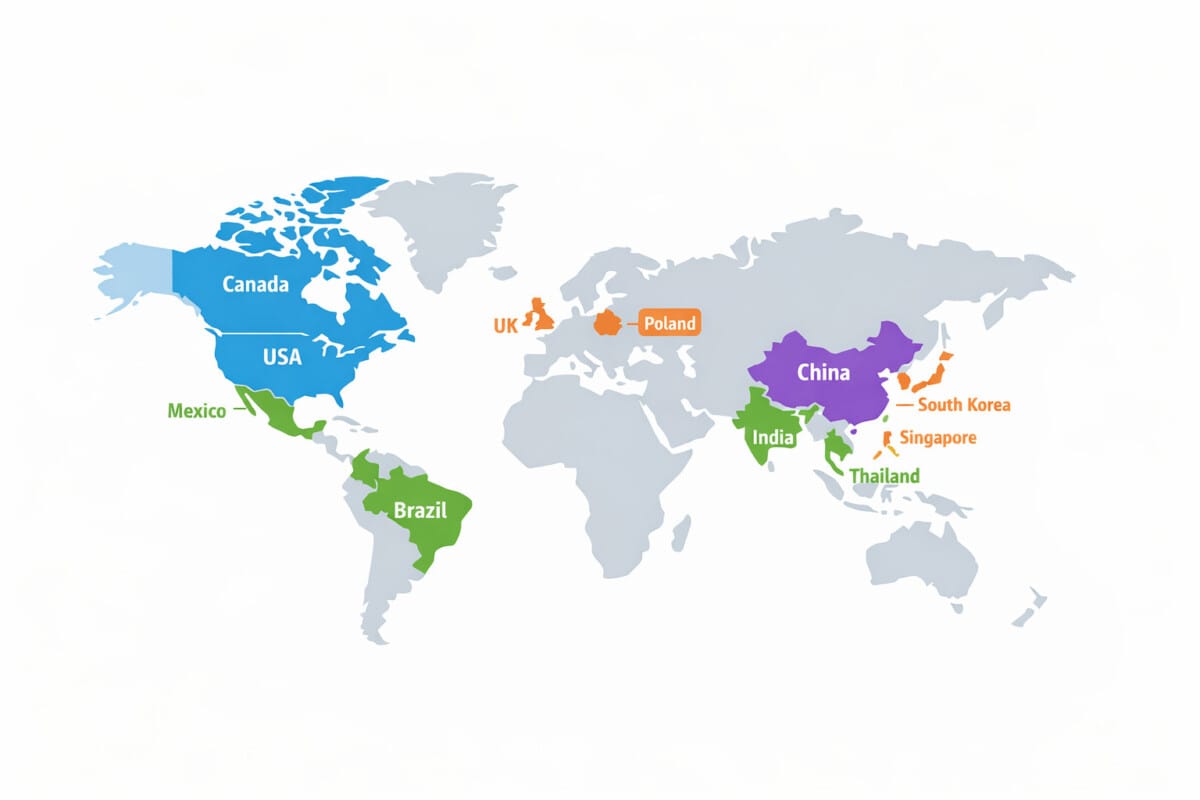
Explore how payment systems are structured across countries, from card-heavy markets to instant-payment-led ecosystems. This page is designed as a visual reference for retail payment infrastructure, domestic rails, and major consumer payment patterns.
Countries in the current version
Regions represented across the map
Payment profiles used for comparison
A key lens for instant payment infrastructure
Asia
Asia includes some of the world’s most dynamic payment ecosystems, from instant-payment-led markets and wallet-dominant environments to structured hybrid systems.
India
Instant-payment-led
India’s retail payment landscape is strongly shaped by UPI and mobile app-based account-to-account transfers.
UPI made instant bank-linked retail payments simple and scalable through app-based consumer experiences.
China
Wallet-led
China remains one of the clearest examples of a wallet-led retail payment ecosystem.
App-based payment ecosystems remain central to everyday retail payment behavior.
South Korea
Hybrid
South Korea combines strong card infrastructure with a mature account-transfer and digital banking environment.
Korea is best understood as a hybrid market rather than a single-rail retail payment market.
Singapore
Hybrid
Singapore combines fast account-based transfers with a highly digital consumer payments environment.
PayNow is a strong reference point for mobile-friendly account-to-account usability.
Thailand
Instant-payment-led
Thailand is a strong example of mobile-linked instant retail payments built around PromptPay.
Thailand is particularly useful as a reference for instant payments linked to domestic and cross-border QR experiences.
Europe
Europe shows both long-established bank transfer systems and strong local payment methods layered on top of cards and broader banking infrastructure.
United Kingdom
Hybrid
The UK combines strong card usage with one of the earlier modern instant payment infrastructures.
Faster Payments remains an important reference point in the history of modern retail real-time payments.
Poland
Hybrid
Poland stands out for BLIK, a strong domestic payment method closely tied to banking apps.
Poland shows how a domestic payment method can become highly visible without fully replacing every other rail.
North America
North America remains highly shaped by cards, even as faster transfer infrastructure becomes more visible.
United States
Card-heavy
The US remains strongly card-oriented, even as FedNow and RTP continue to expand.
The US is a strong example of a market where new rails matter, but legacy card behavior still dominates retail payments.
Canada
Card-heavy
Canada remains card-strong, but Interac e-Transfer is central to the consumer transfer experience.
Canada is useful because it highlights how a card-oriented market can still have a very strong consumer transfer rail.
Latin America
Latin America is one of the most interesting payment regions because of fast-moving domestic innovation and strong public-sector involvement in some key systems.
Brazil
Instant-payment-led
Brazil is one of the clearest examples of an instant-payment-led retail ecosystem built around Pix.
Pix became a global reference point because of how quickly it reached mainstream everyday payment use.
Mexico
Instant-payment-led
Mexico’s payment infrastructure is notable for SPEI, a central-bank-operated transfer system with strong institutional significance.
Mexico is especially useful for comparison because its core fast-transfer infrastructure is closely tied to the central bank.
Payment profiles explained
These labels are simplified comparison categories. They are intended as a visual guide rather than a full analytical taxonomy.
Card-heavy
Consumer payments still rely heavily on cards, even if faster account-based rails are becoming more important.
Instant-payment-led
Real-time account-to-account rails are central to the retail payment experience.
Wallet-led
App-based wallets and platform ecosystems shape everyday payment behavior more than traditional rails alone.
Hybrid
Cards, transfers, wallets, and domestic schemes coexist without one layer fully dominating the market.