
Why tiny payment attempts can be the first warning sign of a much bigger fraud problem
Most payment fraud does not begin with a dramatic purchase. It often starts with something boring: a tiny authorization, a failed low-value transaction, or a burst of card attempts that look harmless on their own. That is exactly why How AI Detects Card Testing Attacks in Real Time matters. Card testing attacks are designed to look small, ordinary, and easy to ignore.
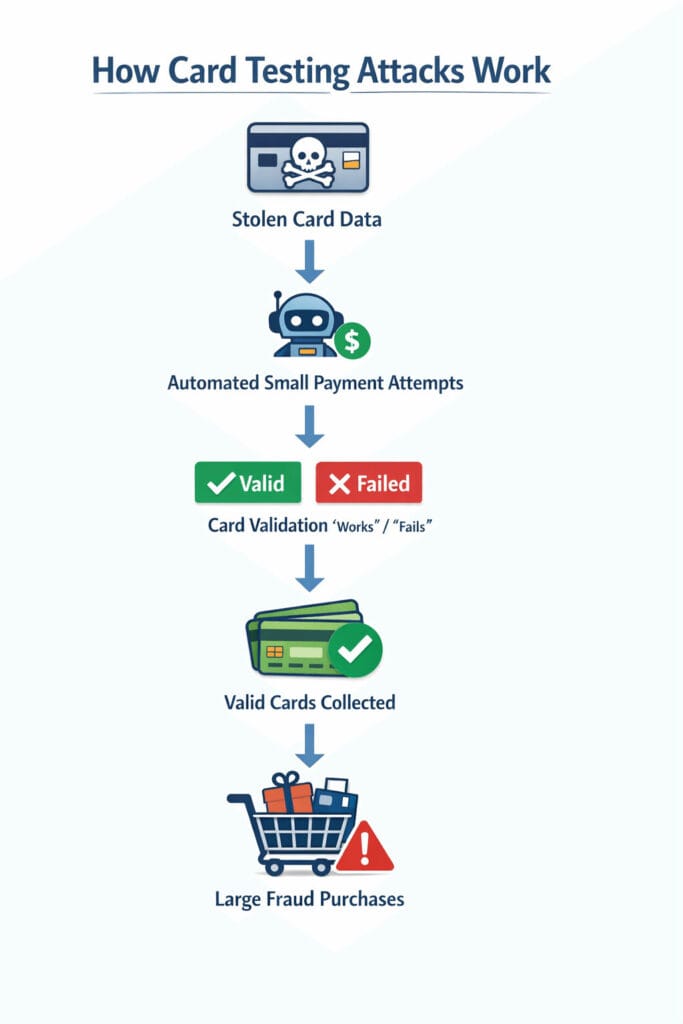
A card testing attack happens when criminals use stolen card details to check whether the card still works. Instead of buying an expensive product right away, they try small authorizations or low-value payments first. If the test works, the card can later be used for larger fraudulent transactions. Stripe describes card testing as an automated fraud pattern that often targets payment or card-saving endpoints and can scale quickly when basic controls are weak.
That is why How AI Detects Card Testing Attacks in Real Time is not just a niche payments topic. It sits right at the intersection of fraud prevention, approval performance, customer experience, and issuer risk management. If a bank or payment provider catches card testing early, it may prevent a much larger fraud wave later. Mastercard has framed card testing as an early indicator of broader card fraud risk, which is exactly why faster detection matters.
The real problem: card testing attacks do not look dangerous at first
The hardest part about card testing attacks is that they rarely look like “classic fraud.” The transaction amount may be tiny. The merchant category may seem normal. The request may not come from an obviously suspicious geography. One single attempt might not trigger any alarm at all.
The danger appears when many of those small attempts are viewed together. That is where the pattern becomes visible. A short burst of low-value authorizations. Similar retry behavior across many cards. A strange mix of declines and approvals. Repeated attempts that move too fast for normal human behavior. This is why How AI Detects Card Testing Attacks in Real Time has become such an important question for banks, issuers, and payment companies.
Traditional rule-based fraud controls still matter, but they are often not enough on their own. A fixed rule such as “block after five failed attempts” can be useful, yet attackers can work around it by distributing traffic across devices, accounts, IP addresses, or time windows. Stripe’s own guidance recommends layered defenses such as CAPTCHA, rate limits, login requirements, and endpoint protection because automated testing attacks are built to exploit weak or predictable controls.
Why AI is better at spotting patterns than static rules
This is where AI changes the game. If rule-based systems are built to detect violations, AI is built to detect patterns.
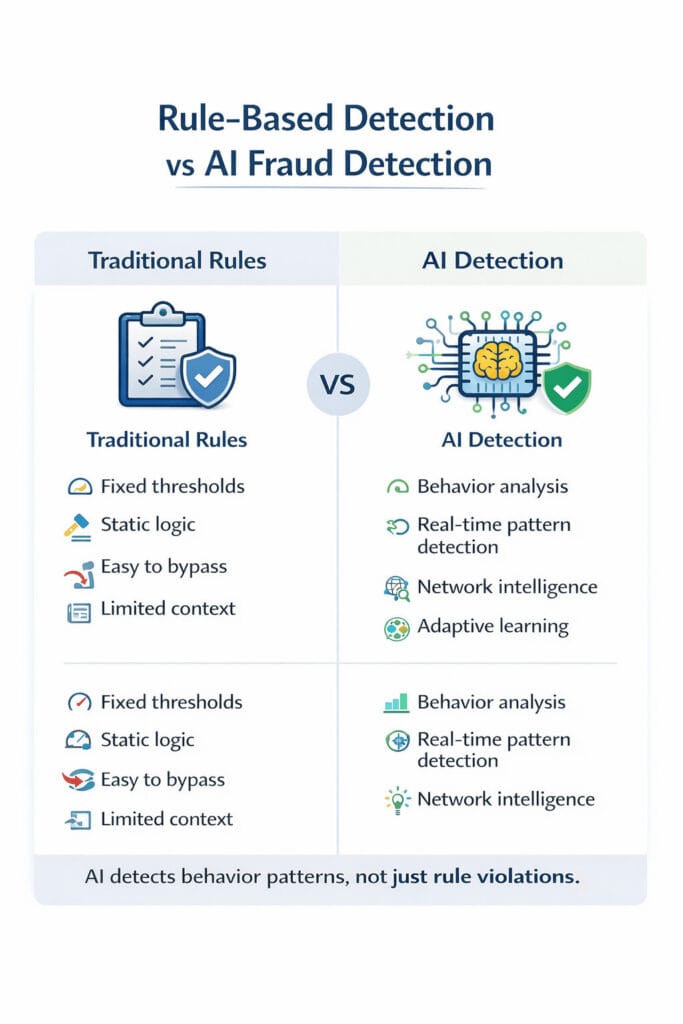
A good AI system does not look at just one transaction in isolation. It looks at how that transaction relates to everything around it. It can evaluate transaction speed, retry behavior, approval-to-decline ratios, merchant patterns, device signals, and similarities to previous fraud campaigns. Visa explains that its AI-based fraud tools generate transaction-level risk scores in real time using hundreds of data points and network-level intelligence.
In simple terms, How AI Detects Card Testing Attacks in Real Time comes down to one core advantage: AI can see behavior that looks normal per transaction but abnormal in aggregate.
That matters because card testing is rarely about one suspicious payment. It is about a sequence of suspicious behavior disguised as ordinary commerce.
What “real time” actually means in payment fraud
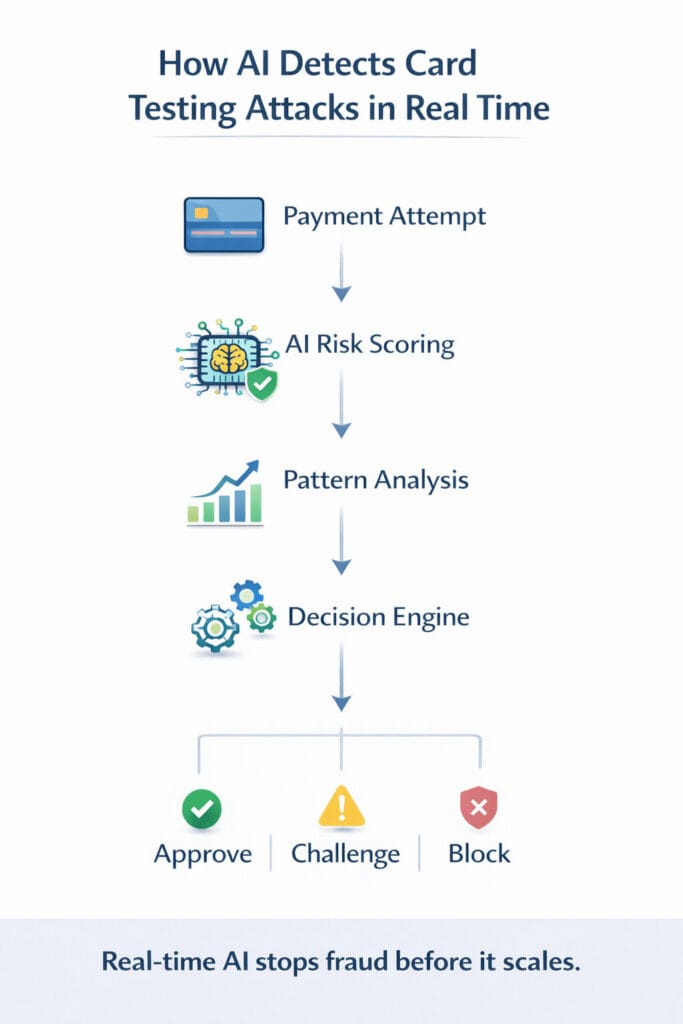
The phrase How AI Detects Card Testing Attacks in Real Time is important because “real time” is not just a buzzword in payments. In this context, it means the system must react during the authorization flow, not hours later in a fraud report.
By the time a human analyst manually notices a testing campaign, the attacker may already have verified hundreds or thousands of live cards. Real-time AI helps reduce that delay. Instead of waiting for damage to pile up, the system can score the risk immediately and support the next action: approve, challenge, throttle, or decline.
Visa says AI-enabled fraud scoring helps support faster decisions during the transaction itself. That speed is critical because card testing attacks are fundamentally a speed problem. Bots do not get tired, and automated scripts can run thousands of payment attempts in minutes.
Here is why real-time detection matters so much:
| Question | Why it matters |
|---|---|
| Why detect early? | Card testing is often the first step before larger fraud. |
| Why is speed critical? | Attackers can validate many cards in a short time. |
| Why use AI? | AI can detect suspicious behavior patterns at machine speed. |
| What is the goal? | Stop fraud while preserving good customer approvals. |
AI is not just about blocking more transactions
One of the biggest misconceptions in payment fraud is that better fraud prevention simply means declining more suspicious payments. In reality, the best systems do not just block more. They block more accurately.
That is especially important in card testing defense because aggressive controls can create false declines. A false decline is a legitimate customer transaction that gets rejected by mistake. In card payments, false declines can hurt approval rates, reduce revenue, and frustrate customers. Visa has explicitly argued that effective AI-based fraud management is not only about stopping bad transactions, but also about helping good transactions go through more smoothly.
That is why How AI Detects Card Testing Attacks in Real Time is really a dual performance story. It is about security, but it is also about precision. A strong AI model should identify suspicious testing behavior without damaging the experience for legitimate cardholders.
This is also why the best banks are not asking only, “Can our AI stop attacks?” They are also asking, “Can our AI stop attacks without hurting approvals?”
Why banks and issuers care about card testing so much
From a bank’s perspective, card testing is not just noise. It is a warning.
If criminals confirm that a card is active, they may use it later for larger purchases, account takeover attempts, or downstream fraud campaigns. Mastercard has highlighted the value of AI in identifying compromised card patterns earlier, before the fraud becomes more costly and more visible.
That shifts the role of fraud defense. Instead of focusing only on fraud after it happens, banks increasingly want to detect the signals that come before the major loss event. Card testing is one of those signals.
So when we ask How AI Detects Card Testing Attacks in Real Time, the better question may be this: how early can a bank recognize that a card testing pattern is forming, and how quickly can it respond before those cards are used at scale?
What AI is actually looking for
A practical way to understand How AI Detects Card Testing Attacks in Real Time is to look at the kinds of signals AI systems may evaluate.
| Signal type | Why it matters in card testing attacks |
|---|---|
| Authorization velocity | Sudden bursts of attempts can signal automation. |
| Decline/approval mix | Testing often produces an unusual pattern of failures and occasional successes. |
| Device and behavior similarity | Different cards may still show linked behavior patterns. |
| Repeated low-value attempts | Small authorizations are common in testing campaigns. |
| Cross-transaction context | One payment may look fine, but many together may not. |
None of these signals alone proves fraud. That is the point. Card testing attacks are subtle. AI becomes powerful because it combines those signals and turns them into a real-time risk view.
If you want a practical breakdown of how card testing works at the merchant and endpoint level, Stripe’s guide on preventing card testing is one of the clearest references. For the issuer and network side, Visa’s overview of AI-based fraud detection explains how real-time risk scoring supports payment decisions.
The bigger lesson behind card testing attacks
The most useful takeaway from How AI Detects Card Testing Attacks in Real Time is that modern payment fraud often starts quietly.
It does not always begin with a stolen luxury item or a massive account drain. It may begin with a small payment that seems too trivial to matter. That is what makes card testing dangerous. It is quiet, repetitive, and easy to underestimate.
But in payments, small signals can have large consequences. A few low-value authorizations may be the beginning of a wider fraud campaign. That is why real-time AI matters. It helps banks detect not just suspicious transactions, but suspicious momentum.
And that is increasingly what strong fraud defense looks like in card payments: not waiting for obvious damage, but identifying the pattern while it still looks small.
