
How Smarter Retries Recover More Revenue
AI failed payment retry timing is becoming one of the most important levers in subscription billing, revenue recovery, and payment operations. Most companies already retry failed payments. The real difference is when they retry. That is where smarter retries can recover more revenue, reduce involuntary churn, and improve payment performance without changing the product, pricing, or customer acquisition strategy.
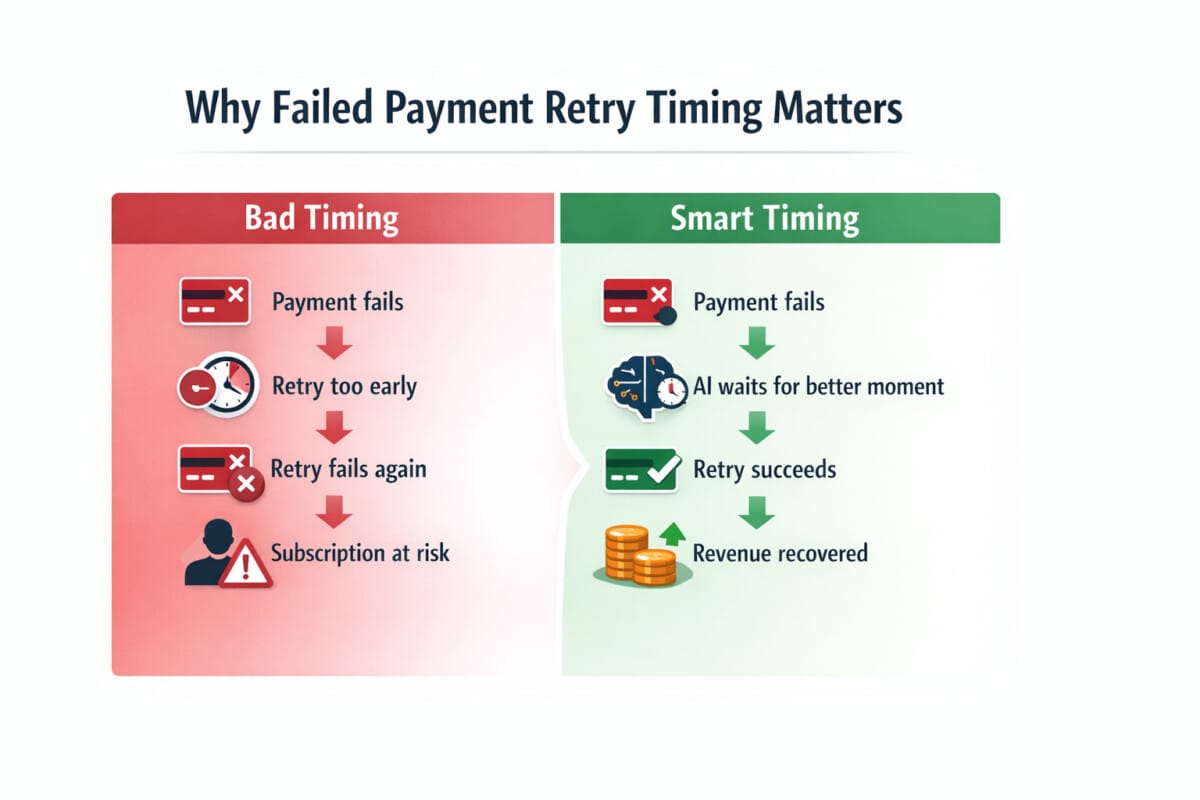
If a customer still wants the service but the payment fails because of a temporary issue, the revenue is not truly gone yet. It is simply trapped behind bad timing.
Failed Payments Are Not Always Lost Revenue
One of the biggest mistakes in recurring billing is treating every failed payment the same way.
A failed payment does not always mean the customer has churned. In many cases, the customer still wants the subscription, still values the product, and has no intention of canceling. The payment may have failed because of temporary insufficient funds, an issuer-side error, a card refresh issue, a soft decline, or a short-lived authentication problem.
That is why failed payment retry timing matters. A payment that fails at one moment may succeed a few hours later, the next day, or right after a paycheck cycle. In subscription businesses, this difference can have a direct impact on monthly recurring revenue.
Why Fixed Retry Rules Often Underperform
Many merchants still rely on simple retry logic.
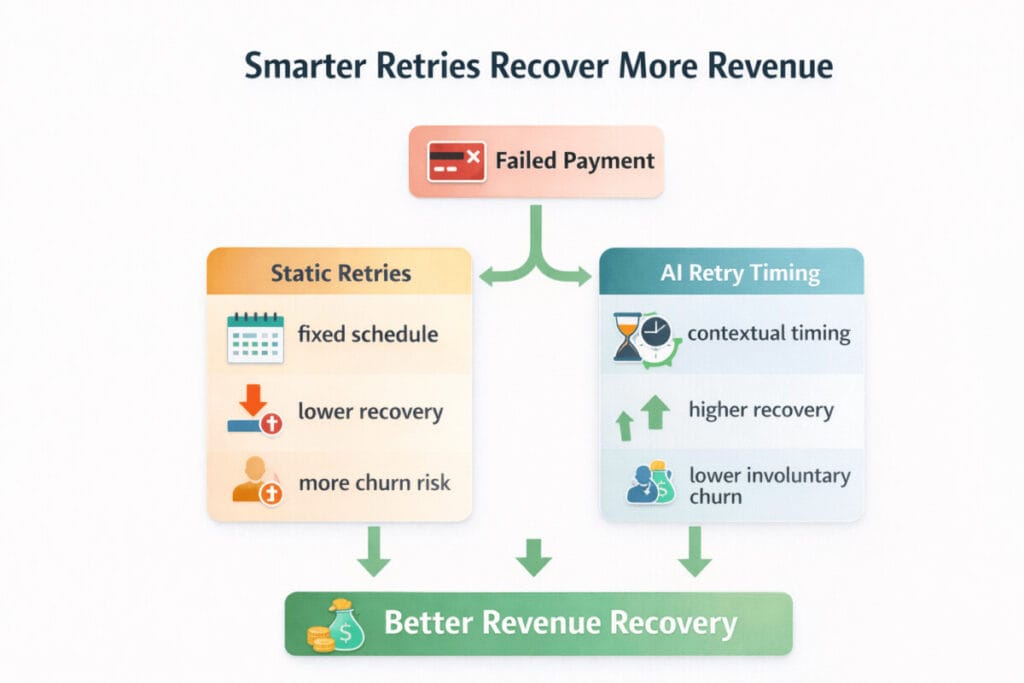
They might retry a failed payment after one day, then three days later, then five days later. This is easy to implement, but it assumes that all failed transactions behave in similar ways. In practice, they do not.
A rigid retry schedule creates several problems.
| Retry Approach | How It Works | Main Strength | Main Weakness |
|---|---|---|---|
| Fixed retry rules | Retries happen on pre-set days | Easy to set up | Ignores payment context |
| Manual retry review | Operations teams decide case by case | More control | Not scalable |
| AI failed payment retry timing | Retries are timed using payment signals and past patterns | More accurate revenue recovery | Requires data and system design |
A fixed model may retry too early, when the customer’s balance has not changed yet. It may retry too often, creating unnecessary payment noise. It may also keep retrying transactions that are unlikely to recover at all.
That is why smarter retries are not just about retrying more. They are about retrying better.
The Real Question Is Not Whether to Retry
The better question is this
When is the next retry most likely to succeed
This is the core idea behind AI failed payment retry timing.
Instead of viewing retry logic as a calendar problem, AI treats it as a probability problem. It looks at patterns in past approvals, issuer responses, customer billing behavior, soft decline history, time-of-day performance, recurring billing cycles, and other payment signals.
That shift changes everything.
A retry system that understands timing can avoid low-probability moments and move closer to high-probability windows. That does not mean every failed payment will recover. It means recoverable payments are more likely to be recovered.
What AI Looks At in Smarter Retries
A modern retry system can evaluate multiple signals before deciding when to retry a failed transaction.
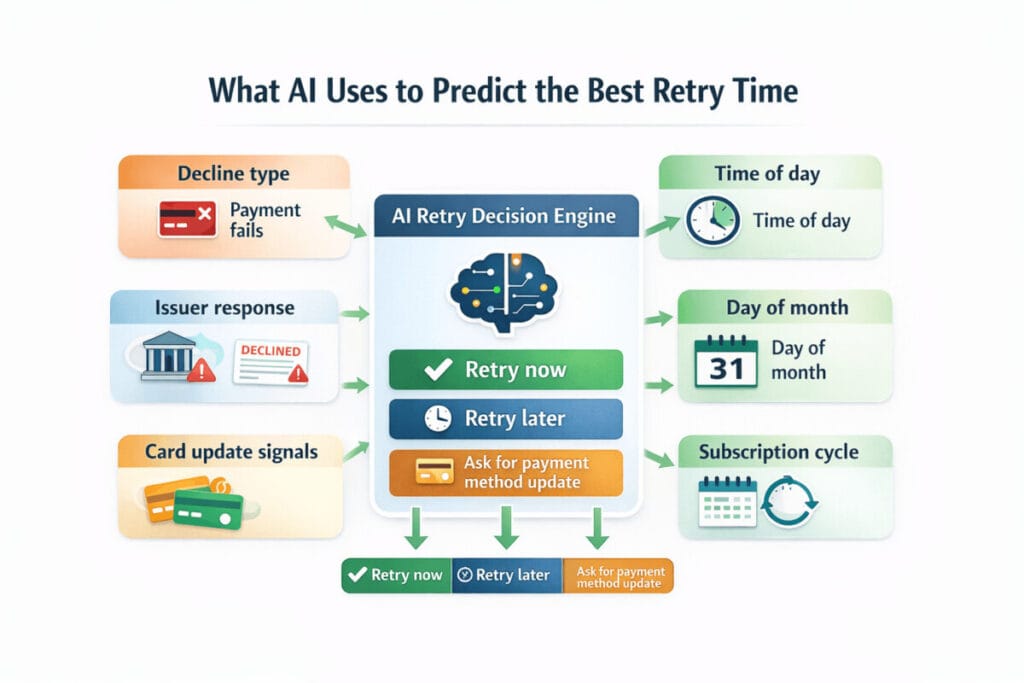
Common inputs may include the following.
| Signal | Why It Matters |
|---|---|
| Decline type | A soft decline behaves differently from a hard decline |
| Issuer response patterns | Some issuers show timing-sensitive approval behavior |
| Customer billing history | Past payment success patterns may repeat |
| Time of day | Authorization performance may vary by hour |
| Day of month | Balance-sensitive payments may succeed after income events |
| Subscription cycle | Retry timing may align with recurring billing behavior |
| Card update signals | Recent card refresh events can change retry success odds |
The important point is that payment retry timing should not be blind. The timing itself can be part of the optimization strategy.
Why This Matters So Much for Subscription Payments
This topic is especially important in subscription payments.
In one-time ecommerce transactions, a failed payment may simply mean the cart is abandoned. In subscriptions, the situation is different. A failed renewal can interrupt service, weaken customer trust, and create involuntary churn even when the customer never intended to leave.
That makes failed payment recovery one of the most overlooked revenue levers in recurring business models.
A company can spend heavily on acquisition, brand, lifecycle marketing, and onboarding. But if too many renewals fail and are not recovered efficiently, revenue leaks quietly in the background.
This is why AI failed payment retry timing is not just a payments topic. It is also a retention topic, a billing operations topic, and a growth topic.
Involuntary Churn Is Often a Timing Problem
Not all churn is product churn.
Sometimes the customer is satisfied, active, and fully engaged. The relationship only breaks because the payment process fails at the wrong moment, and the retry logic is too crude to fix it.
That is what makes involuntary churn so frustrating. The customer did not choose to leave. The billing system let the relationship expire.
In many subscription businesses, reducing involuntary churn by even a small margin can produce a meaningful lift in recovered revenue. That is why revenue recovery deserves more attention in the broader conversation around payments and retention.
Soft Declines Create a Major Opportunity
One reason this topic is so valuable is that soft declines create a real recovery opportunity.
A hard decline often points to a problem that will not be solved by waiting. A soft decline may reflect a temporary issue. In those cases, the retry itself is not the whole strategy. The timing of the retry becomes the strategy.
This is where AI failed payment retry timing can outperform traditional retry schedules. Instead of firing off repeated attempts on a fixed timetable, a smarter system waits for stronger recovery conditions.
That approach can improve authorization recovery while reducing unnecessary retry pressure.
More Retries Do Not Always Mean More Revenue
This is one of the most important ideas in payment optimization.
A business may assume that more attempts will naturally recover more failed payments. In reality, the opposite can happen. Poorly timed retries can create wasted attempts, operational noise, weak customer experiences, and little incremental recovery.
The goal of smarter retries is not volume. The goal is precision.
A stronger retry strategy should aim to do the following.
- Identify recoverable failed payments
- separate soft declines from low-recovery cases
- Choose better retry windows
- Reduce unnecessary attempts
- improve revenue recovery
- lower involuntary churn
That is a much more strategic view than simply adding more retries to the billing workflow.
Not Every Failed Payment Should Be Retried
This is where good payment strategy becomes more mature.
Some failed payments are better handled through other actions, such as requesting an updated payment method, prompting authentication, or moving the customer into a recovery flow. If the card is no longer valid or the account is closed, retry timing alone will not solve the problem.
That means the real power of AI in failed payment retry timing is not only in retrying the right payment at the right time. It is also in recognizing when retrying is not the best next move.
The best systems do both.
The Bigger Shift in Payment Operations
The broader story here is not just about AI. It is about the evolution of payment operations.
For years, many billing teams treated retries as a routine back-office process. That is changing. Retry logic is becoming a meaningful part of growth strategy because recurring revenue businesses now understand that a failed payment is not always the end of the customer relationship.
Sometimes it is just a badly timed request.
That is why AI failed payment retry timing deserves attention. It turns retries from a mechanical workflow into a smarter revenue recovery system.
Final Takeaway
The future of failed payment recovery will not belong to the businesses that retry the most.
It will belong to the businesses that retry at the right moment.
That is the real promise of AI failed payment retry timing. It helps merchants move beyond static retry schedules, recover more subscription revenue, reduce involuntary churn, and treat failed payments as recoverable opportunities rather than automatic losses.
In payments, timing has always mattered.
Now it is becoming measurable, optimizable, and increasingly intelligent.
