
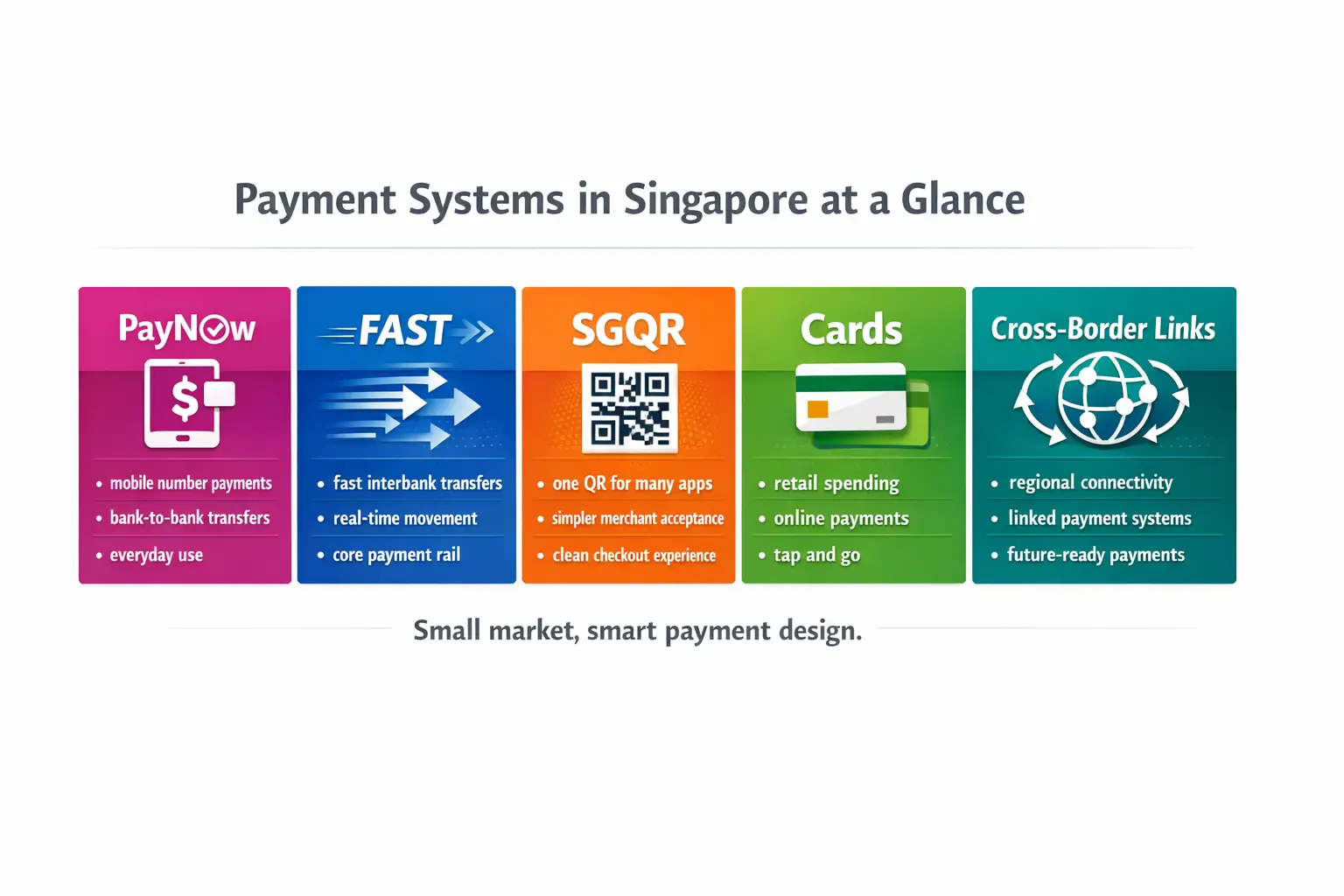
From PayNow and FAST to SGQR and cross-border payment links, here is how payment systems in singapore actually work
You buy coffee from a small shop.
You scan a QR code.
You send money to a friend using just a mobile number.
You move on with your day in seconds.
That is what makes payment systems in singapore so interesting. Singapore is not a huge country. It does not have the scale story of India or the regional complexity of Europe. But when it comes to payment design, it has built one of the cleanest and most practical systems anywhere.
And that is the big idea.
payment systems in singapore feel modern not because one app took over everything, but because the system was built to make digital payments simple, fast, and deeply usable in everyday life.
Singapore feels efficient because the payment system is designed that way
Some countries have fast payments. Some have good QR payments. Some have strong bank transfer systems. Singapore stands out because these pieces feel connected.
That is what makes payment systems in singapore different. The system does not feel like a pile of separate payment products. It feels like a coordinated digital payment environment.
You can see that clearly in the way Singapore built around a few key ideas: fast bank transfers, easy alias-based payments, simpler QR acceptance, and stronger cross-border connectivity. Those ideas may sound technical, but in real life they translate into something much easier to understand. Payments feel smooth.
PayNow is the most visible part of payment systems in singapore
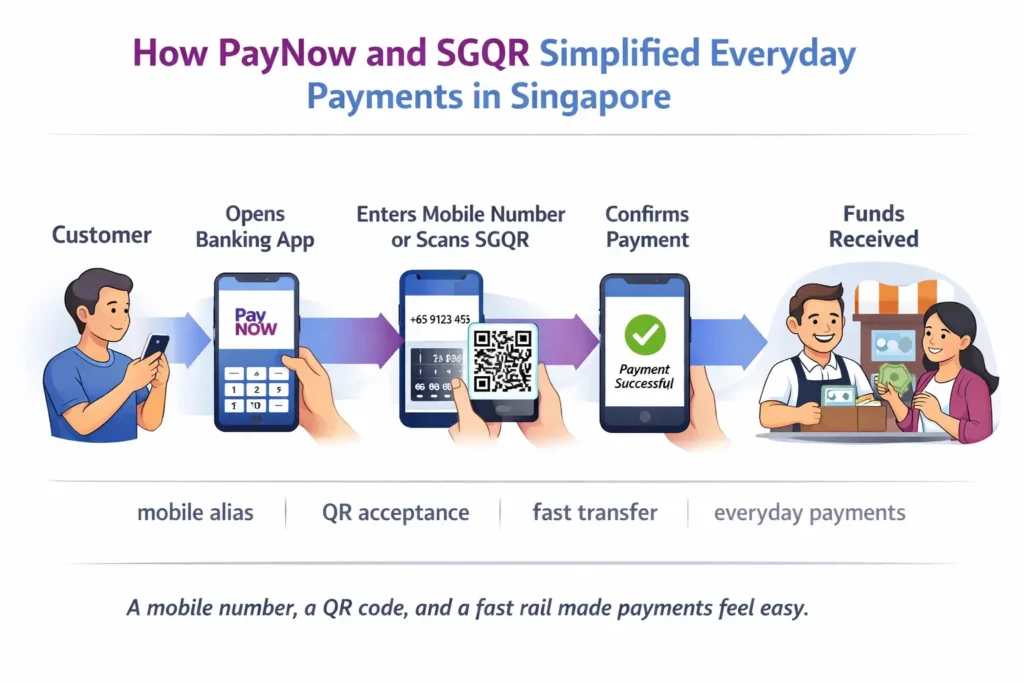
If there is one name that defines payment systems in singapore, it is probably PayNow.
PayNow lets users send and receive Singapore dollar funds using a mobile number, and businesses can receive money through identifiers like their UEN. That matters because it removes friction. People do not want to type long bank details every time they send money. They want payments to feel simple, direct, and immediate. ABS describes PayNow as a service that lets you send and receive Singapore dollar funds from one bank to another using a mobile number, and MAS/ABS have repeatedly positioned it as one of Singapore’s core national payment schemes. (ABS)
That is why PayNow became such an important part of payment systems in singapore. It made account-to-account payments feel easier for normal people, not just for banking professionals or large businesses.
And that matters more than it sounds. The best payment systems are not just technically strong. They make digital money movement feel natural.
FAST is the speed layer underneath
Behind that smoother experience is FAST, short for Fast And Secure Transfers.
FAST matters because it helps explain why payment systems in singapore feel quick in the first place. It is one of the key rails that made near-instant interbank fund transfers part of Singapore’s everyday payment reality. MAS and ABS continue to group FAST alongside PayNow and SGQR as core national payment schemes in Singapore. (ABS)
That is one of the reasons Singapore’s payment story is so strong. Users may think they are simply sending money from one app to another, but underneath that simple moment sits a much more deliberate infrastructure design.
In other words, the experience feels easy because the rail underneath was built to support speed.
SGQR made merchant payments simpler
One of the smartest pieces of payment systems in singapore is SGQR, the Singapore Quick Response Code.
SGQR matters because QR payments can get messy when merchants need to display too many codes from too many providers. Singapore’s answer was to simplify that experience. MAS describes SGQR as the world’s first unified payment QR code, combining multiple payment QR codes into a single label, and says consumers can use a payment app accepted by the merchant to scan the SGQR and pay. (mas.gov)
That is a very Singapore-style solution. It is not just about adding one more payment feature. It is about reducing clutter so the entire payment environment works better.
This is a big reason payment systems in singapore feel so polished. The system does not only focus on consumer convenience. It also tries to make payment acceptance cleaner for merchants.
Singapore is also thinking beyond domestic payments
Another reason payment systems in singapore matter globally is that Singapore is not only focused on domestic payments.
It is also pushing cross-border payment connectivity. MAS highlights cross-border payment linkages as part of its e-payments work, and Singapore has already been linked publicly with real-time payment corridors such as PayNow-DuitNow with Malaysia.
That matters because the future of payments is not only about how smoothly money moves inside a country. It is also about how smoothly it can move across borders without becoming slow, expensive, or confusing.
That makes payment systems in singapore especially interesting in this series. Singapore is small, but it behaves like a country building for regional relevance.
Cards still matter, but they are not the whole story
Of course, cards still matter in Singapore. People still tap cards in stores, use them online, and rely on them for everyday retail spending.
But the more interesting story in payment systems in singapore is that cards are no longer the only obvious center of digital payments. Bank-linked and QR-based payment habits are much more visible in daily life than many outsiders expect.
That is what makes Singapore feel different from places where cards still dominate the imagination of digital payments. In Singapore, the modern payment story is more balanced. Cards matter, but fast transfers, mobile-linked payments, and QR acceptance matter a lot too.
Why payment systems in singapore get so much respect
People respect payment systems in singapore because Singapore shows what happens when a country treats payments like infrastructure instead of just a collection of apps.
That is the deeper story.
The system is not impressive because it looks flashy. It is impressive because it reduces friction again and again. Alias-based transfers make money easier to send. FAST helps it move quickly. SGQR makes acceptance cleaner. Cross-border linkages make the system look outward instead of staying domestic.
That kind of design discipline is hard to miss.
Why this matters even if you do not live in Singapore
Understanding payment systems in singapore is useful even if you never use PayNow yourself.
It shows what modern payments can look like when the system is built around usability instead of fragmentation. It shows that a country does not need massive scale to build a strong payment environment. And it shows that small design choices, like reducing QR clutter or letting people use mobile numbers instead of bank account details, can completely change how payments feel.
That is one reason Singapore matters so much in global payment discussions. It is not the biggest system. It is one of the cleanest.
Final thoughts
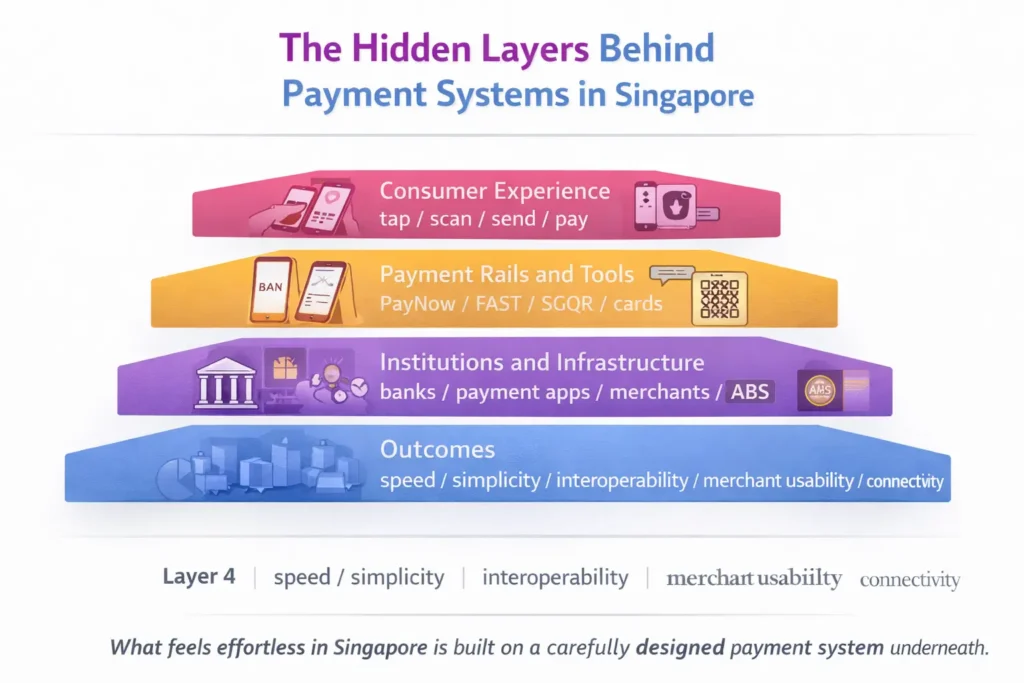
The simplest way to understand payment systems in singapore is this: Singapore built a payment system that feels fast because the infrastructure underneath was designed to remove friction.
PayNow made account-to-account payments easier. FAST helped build the speed layer. SGQR made QR acceptance cleaner. Cross-border payment links pushed Singapore beyond domestic convenience toward regional relevance.
That is why Singapore stands out. It shows that a small country can still build a payment system that feels smarter than systems much larger than itself.
References
- Association of Banks in Singapore – PayNow
https://www.abs.org.sg/PayNow - Monetary Authority of Singapore – Singapore Quick Response Code (SGQR)
https://www.mas.gov.sg/development/e-payments/sgqr - Monetary Authority of Singapore – Cross-border Payment Linkages
https://www.mas.gov.sg/development/e-payments/cross-border-payment-linkages - MAS and ABS to Establish New Payments Entity to Position National Payment Schemes for Next Stage of Growth
https://www.mas.gov.sg/news/media-releases/2025/mas-and-abs-to-establish-new-payments-entity
Read the Full Payment Systems Series
| Country / Region | Main Focus | Read More |
|---|---|---|
| United States | Cards, ACH, wire transfers, RTP, FedNow | Payment Systems in US |
| India | UPI, QR payments, NEFT, RTGS, RuPay | Payment Systems in India |
| Brazil | Pix, QR payments, cards, boleto | Payment Systems in Brazil |
| Europe | SEPA, instant payments, SCT Inst, TIPS | Payment Systems in Europe |
| Singapore | PayNow, FAST, SGQR, cross-border links | Payment Systems in Singapore |
