
Is unemployment paid by workers, employers, or the government?
Who pay Unemployment? Losing a job has a cruel way of making boring questions feel urgent.
A week ago, “unemployment insurance” might have sounded like one of those dry payroll terms that live in HR manuals and tax forms. Then life changes. The paycheck stops. The rent does not. And suddenly a blunt little question becomes very real:
Who pays unemployment?
That is why people search phrases like “who pay unemployment” instead of polishing the grammar first. They are not trying to impress Google. They are trying to figure out where the money actually comes from. Is it taken out of a worker’s paycheck? Does a former employer keep paying after a layoff? Or is it just the government stepping in with money from somewhere else?
The short answer is simple, but the full answer is much more interesting.
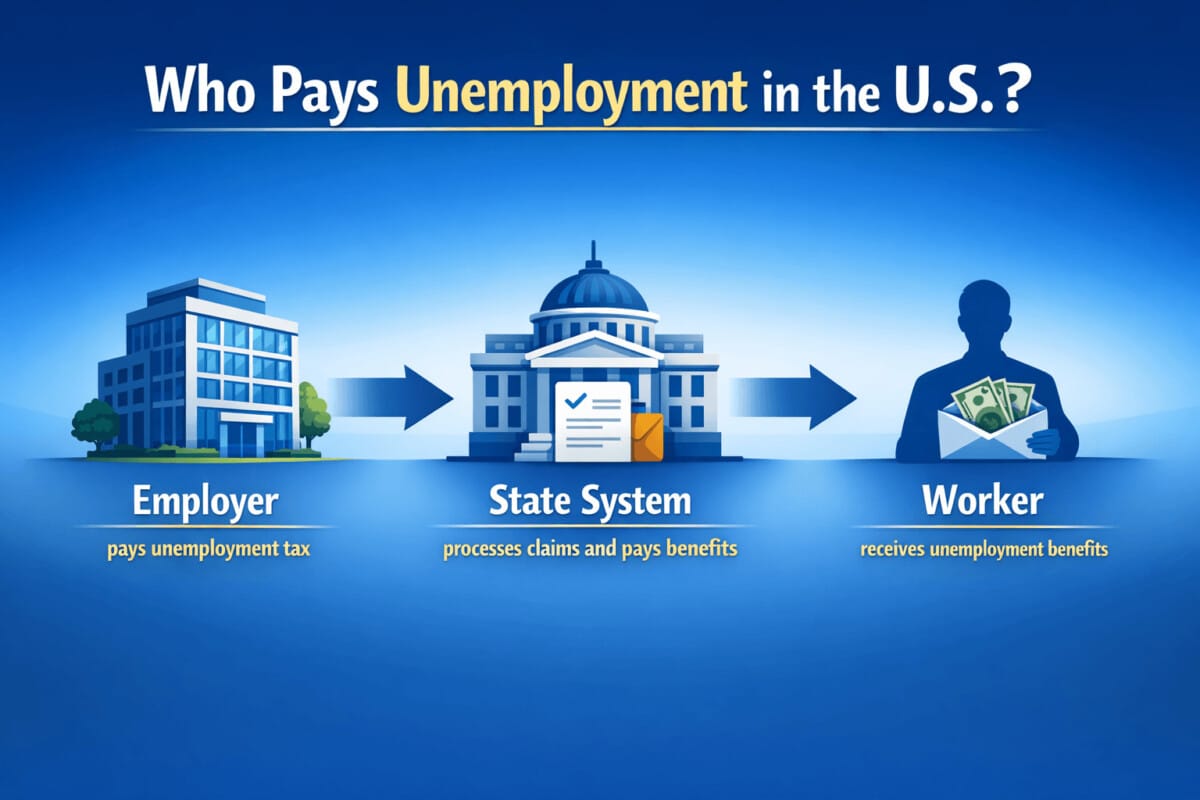
In the U.S., employers usually fund unemployment taxes, states usually run the claims system, and unemployed workers receive the benefits. The IRS says that most employers pay both a federal and a state unemployment tax, and that only the employer pays FUTA tax; it is not withheld from the employee’s wages.
Why does this question feel more confusing than it should
Part of the confusion comes from the fact that unemployment sits in a strange place between payroll, public policy, and survival.
When people think about taxes, they usually think about deductions. Money leaves a paycheck. It gets labeled. It hurts a little. So it feels natural to assume unemployment must work the same way. If workers may need unemployment benefits later, maybe they must be paying into the system now.
But that is not how the federal piece works. The IRS is very clear that FUTA is paid from the employer’s own funds and is not withheld from employee pay.
That single detail changes the whole story. Unemployment insurance is not usually a little jar filled by workers every payday. It is much closer to an employer-funded insurance structure that exists to soften the financial crash of job loss. The worker may be the one receiving the benefit, but the worker is not usually the one directly paying FUTA into the system.
Employers fund it, but states usually pay it
This is the part that many people do not realize until they have to file a claim.
A common mental picture goes like this: a company lets someone go, so the company must somehow keep paying that person through unemployment. It sounds intuitive. It is also mostly wrong.
The U.S. unemployment insurance system is jointly run by federal and state governments. According to CBPP, states levy a payroll tax on employers to finance regular unemployment insurance benefits, while the federal government also levies a payroll tax under FUTA that mainly finances the administration of state UI programs.
That is why unemployment usually does not arrive as a check from your former employer. It usually comes through the state unemployment insurance system because the state is the one handling the claim, the eligibility review, and the payment process. The structure matters: employers generally fund the system, but the state generally operates the machine.
Once you see that, the whole thing feels less mysterious. Unemployment is not a severance payment in disguise. It is a public insurance system with a payroll-tax backbone.
Does unemployment come out of your paycheck?
This is usually the real question hiding underneath the keyword.
And for federal unemployment tax, the answer is straightforward: no.
The IRS says employees do not pay FUTA tax and do not have it withheld from their pay.
That matters because payroll already feels crowded. Federal income tax, Social Security, Medicare, and sometimes state taxes all show up before the money even lands in your account. It is easy to assume unemployment is just another bite taken before payday.
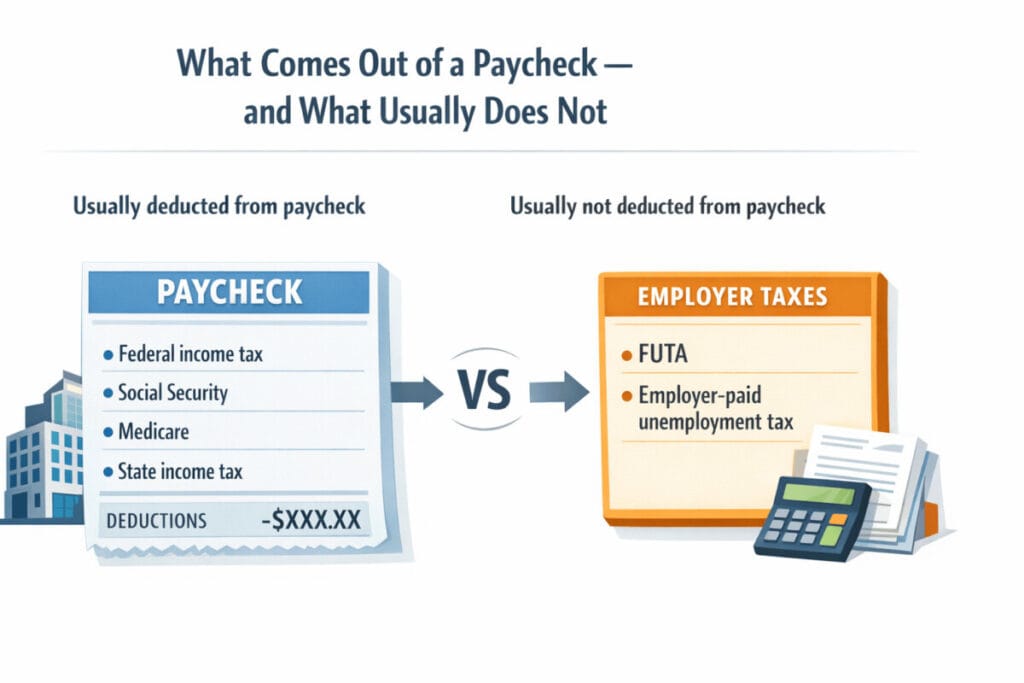
But FUTA is different. The federal unemployment tax is an employer obligation. That does not mean the economics are always invisible; employer taxes can still affect hiring costs and compensation over time. But in the legal and administrative sense that most people actually care about, FUTA is not the usual kind of employee paycheck deduction.
So if someone asks, “Am I paying unemployment out of my paycheck?” the clean answer is:
Not in the usual federal FUTA sense. Your employer is paying that tax.
What the federal government does, and what the states do
Another reason this topic stays confusing is that the U.S. system has layers.
People say, “The government pays unemployment,” which is true in the loosest possible way but not very helpful. A better answer is that the states and the federal government play different roles.
CBPP explains that states levy employer payroll taxes to finance regular unemployment benefits, while the federal government levies FUTA mainly to finance the administration of state UI programs.
That means the picture looks more like this:
- Employers generally fund the system through unemployment taxes
- States generally handle claims and pay regular benefits
- The federal government supports the framework and administration behind the system
That is a much more useful answer than simply saying “the government pays.” The government is part of the system, yes. But the money flow starts with an employer-funded tax structure, not a mystery pile of cash floating above the economy.
Why is this more than a tax question?
At first glance, “who pay unemployment” looks like a plain payroll question. In reality, it is a story about financial infrastructure.
Think about what has to happen for unemployment insurance to work at scale.
Employers report payroll.
Taxes are assessed.
Funds move through formal trust structures.
Workers file claims.
Eligibility is reviewed.
Benefits are paid out.
That is not just policy. That is a live money-movement system.
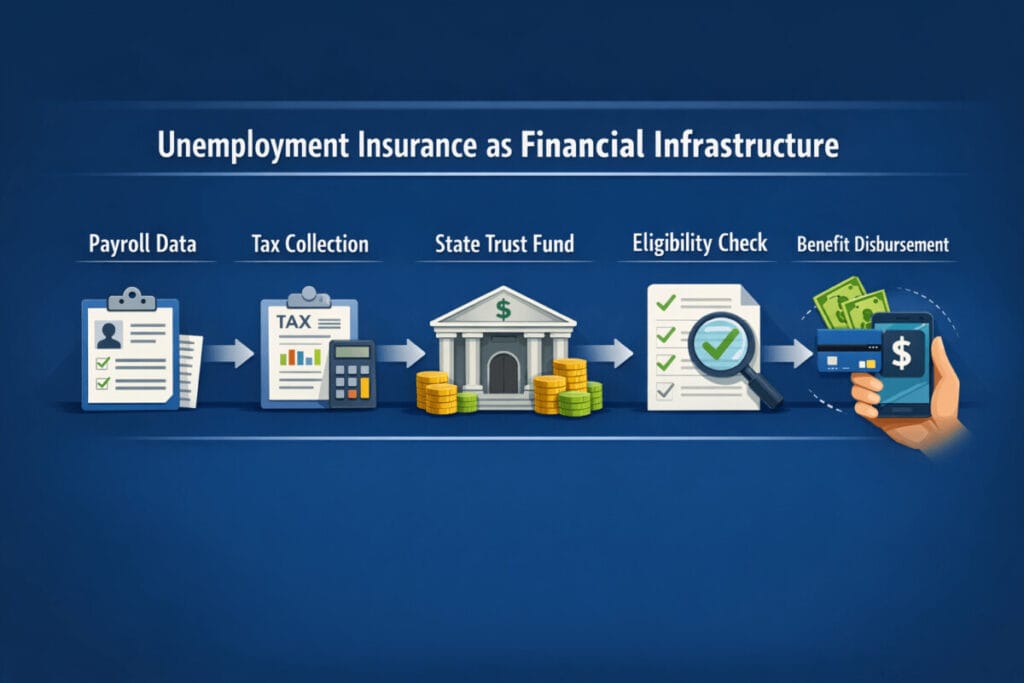
CBPP notes that the financial transactions of the federal-state UI system move through the Unemployment Trust Fund framework.
Once you see it that way, unemployment looks less like a sleepy government benefit and more like a public-sector payments network. It collects money from one part of the economy, organizes it inside a formal system, and releases it when households suddenly lose income. That is not boring. That is the financial plumbing of economic shock absorption.
If you are a worker, here is what actually matters
If you are reading this because you lost a job, the most important thing to understand is this:
Who funds the system and who qualifies for benefits are not the same question.
Even though employers generally fund unemployment taxes, that does not mean every former employee automatically gets paid. States run the claims process and determine eligibility under state rules. That is why unemployment can feel simple in theory and frustrating in practice. The funding source may be clear, but the qualification gate is still real.
So yes, the employer-funded structure is the foundation. But whether you personally receive benefits depends on how your state evaluates your claim, your work history, and the circumstances of the job loss.
That distinction is one of the reasons people keep searching this topic. They are not just asking where the money comes from. They are trying to understand why the money can still feel hard to reach.
If you are an employer, this question hits differently
For workers, this is a household cash-flow question. For employers, it is a payroll-cost question.
Small business owners usually meet this topic not through policy debates but through payroll software, tax deadlines, or the sudden realization that hiring comes with more than wages. The question turns practical fast:
Do I pay unemployment tax for every employee?
What is FUTA?
Why is there both a federal and a state unemployment tax?
The IRS gives the basic federal rule: the FUTA tax rate is 6.0% on the first $7,000 paid to each employee each year, though employers may generally receive a credit of up to 5.4% for state unemployment taxes paid under the rules, which can reduce the effective FUTA rate.
That makes unemployment tax more than a policy concept. It becomes part of the cost of employing people in America. And that is where this whole topic becomes more human than it first appears. For the worker, unemployment is a lifeline. For the employer, it is part of the price of keeping a payroll. The same system looks completely different depending on which side of the paycheck you stand on.
The scale of the system is bigger than most people think
It is easy to imagine unemployment insurance as a small side program until the numbers remind you otherwise.
The Department of Labor’s FY 2026 budget materials project that states will collect $46.7 billion in state unemployment taxes and pay an estimated $41.2 billion in federal and state unemployment benefits to 5.9 million beneficiaries.
That is not a niche administrative function. That is a major operating system for moving money through the economy when jobs disappear. It exists to take employer-funded tax flows and turn them into household income support when work vanishes faster than bills do.
Seen that way, the keyword “who pay unemployment” is not small at all. It opens the door to one of the clearest examples of public financial infrastructure in the U.S.
So who really pays unemployment?
The most honest answer depends on what you mean.
If you mean who funds unemployment insurance, the answer is usually employers, through federal and state unemployment taxes.
If you mean who sends unemployment money to workers, the answer is usually the state unemployment insurance system.
If you mean whether it comes out of an employee paycheck, the federal FUTA answer is no.
And if you mean whether the government is involved, the answer is also yes, but in a layered way: states finance regular benefits and handle claims, while the federal government supports administration and the broader framework behind the system.
Final takeaway
The phrase may be rough, but the question underneath it is sharp.
Who pays when a paycheck stops?
In the U.S., unemployment insurance is built so that employers generally fund the taxes, states generally administer and pay the benefits, and workers receive the support if they qualify. It is not usually a direct deduction from an employee’s paycheck as FUTA, and it is not usually a former employer mailing checks after a layoff.
It is a system.
A tax structure.
A claims engine.
A public financial shock absorber.
And once you understand that, “who pay unemployment” stops sounding like a clumsy search phrase and starts sounding like a very smart question.
