
Not today, but that is not a reason for payment systems to relax
Payments are strangely quiet.
You tap your phone at a coffee shop, approve a transfer in a banking app, or type your card details into an online checkout page. On the surface, the whole thing feels simple. A message flashes for a second, the screen changes, and the money moves.
Payment successful.
That is all most people ever see.
But underneath that one-line confirmation sits a much longer story: authentication, key exchange, digital signatures, message integrity, certificate validation, and encrypted communication between systems that are expected to trust each other instantly. Somewhere deep in that stack lives public-key cryptography, and one of the most important names in that world has long been RSA.
That is where the real question begins.
If quantum computing becomes powerful enough, could it eventually undermine the cryptographic assumptions that have supported digital payments for decades? That possibility is serious enough that NIST has already moved ahead with post-quantum cryptography standardization, and the BIS has been urging the financial sector to begin quantum-readiness planning now, not later.
See NIST’s post-quantum cryptography project and the BIS paper on Quantum-readiness for the financial system.
Why RSA is suddenly part of a payments conversation
RSA is not just another technical acronym buried in a security manual. For years, it has played a central role in secure digital communication, identity verification, and signature-based trust. The reason it works is conceptually simple: factoring very large numbers is extremely hard for classical computers.
That assumption has held up well for a long time.
Quantum computing changes the discussion because it introduces a very specific threat, not just a vague promise of faster computation. The key idea is Shor’s algorithm, a quantum algorithm designed to solve integer factorization much more efficiently than classical methods. IBM’s quantum learning materials explain why Shor’s algorithm matters so much: it targets exactly the kind of mathematical hardness that RSA depends on.
A useful overview is IBM Quantum’s page on Shor’s algorithm.
IBM has a good explanation of Shor’s algorithm
https://quantum-computing.ibm.com/learn/shor-algorithm
That is the point that many articles blur.
The issue is not simply that “quantum computers are faster.” The issue is more precise and more unsettling:
A known quantum algorithm exists that directly threatens the mathematical foundation of RSA.
That makes this a payments story, not just a physics story.
Why payment systems should care more than most industries
Payments are not just software features. They are a trusted infrastructure.
Every payment message has to prove something. It has to prove who sent it, whether it was altered, whether the approval chain is genuine, whether the receiving system should accept it, and whether the final response can be trusted. In other words, payments do not just move money. They move verified trust in real time.
That is why cryptographic weakness matters so much here.
If RSA eventually becomes unsafe at scale, the problem is not limited to one login screen or one certificate renewal. It affects a much broader system: interbank messaging, institutional authentication, payment gateway security, digital signatures, and the hidden trust rails that sit behind card transactions, account-to-account transfers, and financial APIs.
The BIS has emphasized that one of the first practical steps for financial institutions is not panic, but visibility: institutions need to understand where vulnerable cryptography is currently used and how deeply it is embedded across systems, vendors, and external connections. That is what makes the transition difficult. Payments are highly interconnected. One institution cannot fully migrate in isolation.
The most common question: “So can quantum computers break payment encryption today?”
The short answer is no, not at scale, and not today.
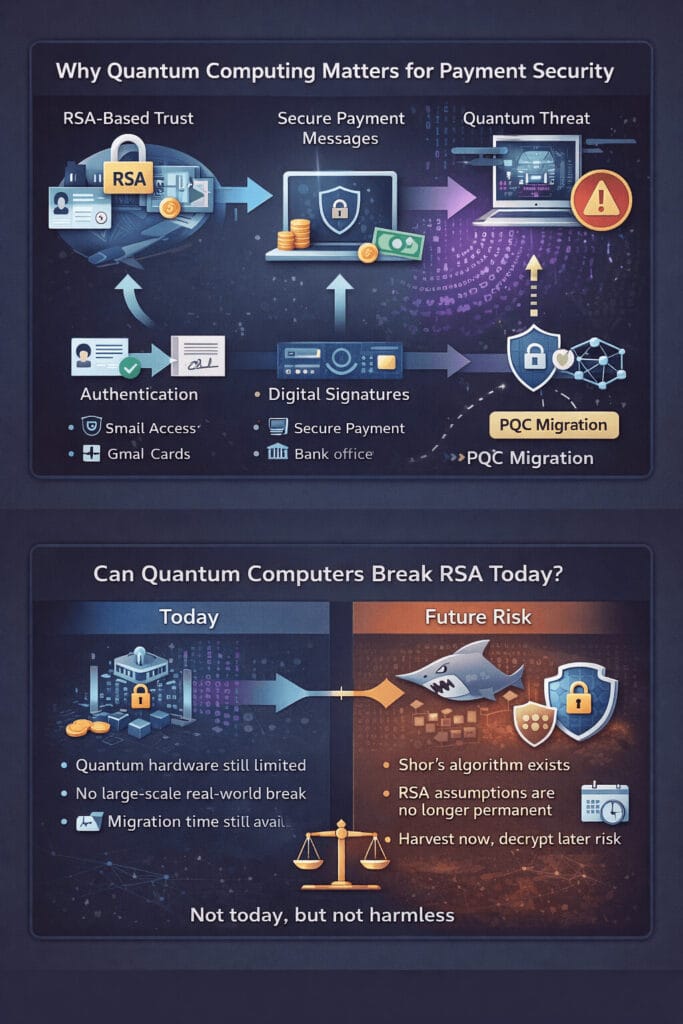
That matters because this topic is often exaggerated into a headline-friendly apocalypse. We are not in a world where major payment networks are suddenly collapsing because a quantum computer has broken RSA in production. The BIS has consistently described quantum computing as a future-changing force, but not as an immediate cause of systemic breakdown in current financial infrastructure.
For context, see the BIS report on quantum computing and the financial system.
But this is where the story becomes more interesting.
“Not today” is not the same thing as “not a problem.”
That distinction is everything.
Financial infrastructure does not change overnight. Payment systems are deeply layered, heavily regulated, and tied to vendors, counterparties, hardware security modules, certificate lifecycles, and long migration windows. In practice, a cryptographic change in payments is rarely a simple patch. It looks more like a long infrastructure relocation.
That means waiting until the threat becomes fully practical is a bad strategy.
By the time a large-scale quantum attack is feasible, the organizations that delayed preparation may discover that they are years behind on inventory, testing, interoperability, and rollout planning.
The risk that gets overlooked: harvest now, decrypt later
One of the most important ideas in the quantum security discussion is also one of the least dramatic-sounding:
Harvest now, decrypt later.
The concept is simple. Sensitive encrypted data can be collected today, stored for years, and decrypted later if quantum capabilities become strong enough. That makes the time horizon more complicated than people assume. An organization does not need to wait for a full-scale quantum attack to have a quantum problem. If valuable data is being captured now and remains sensitive long enough, the transition clock has effectively already started.
This matters differently across different payment and financial data types.
A short-lived retail authorization record may not matter much a decade later. But long-lived institutional communications, signed financial records, legal evidence trails, and system-to-system trust material are a different story. Some data loses value quickly. Some does not.
That is why the first serious quantum-readiness step is rarely “deploy a new algorithm tomorrow.” It is usually something less glamorous and far more important:
Figure out where your cryptography actually lives.
A clearer way to think about the issue
Here is the simplest way to frame it.
| Question | Practical answer today | Why it matters |
|---|---|---|
| Does quantum computing threaten RSA in principle? | Yes | Shor’s algorithm directly targets the hardness assumption behind RSA. |
| Are payment systems being broken by quantum computers right now? | No | Current hardware is not yet at the point of breaking RSA across real-world payment infrastructure at scale. |
| Can the industry wait until the threat is immediate? | No | Payment infrastructure migrations take years, and cryptography is embedded across many interconnected layers. |
| Is the industry already moving? | Yes | NIST has already standardized key post-quantum cryptographic algorithms, and financial-sector planning has started. |
NIST’s 2024 announcement on approved post-quantum cryptography standards is one of the clearest signs that this is no longer just a theoretical debate.
See NIST’s announcement on approved PQC FIPS.
What this means for banks, PSPs, and payment infrastructure operators
This is where the conversation gets practical.
If you run or support payment infrastructure, the first mistake is overreacting. The second mistake is doing nothing. Of the two, doing nothing is usually worse.
The more realistic path looks like this:
1. Build a cryptographic inventory
Before discussing migration, institutions need to know where RSA and other potentially vulnerable cryptographic components are being used. That includes certificates, APIs, device authentication, internal messaging layers, hardware modules, vendor systems, and external network connections.
2. Separate short-lived data from long-lived trust assets
Not all cryptographic exposure has the same urgency. Data with a long sensitivity horizon should move higher on the priority list.
3. Expect hybrid periods
The likely future is not a dramatic “RSA disappears overnight” moment. It is more likely a hybrid transition period where classical and post-quantum approaches coexist while interoperability, performance, and operational trust are tested.
4. Treat migration as infrastructure work, not just crypto work
Post-quantum migration affects architecture, vendors, governance, procurement, testing, compliance, and business continuity. This is much bigger than choosing a new algorithm from a standards list.
The future will probably be slow, expensive, and unavoidable
That may not sound exciting, but it is probably the most realistic outlook.
The transition to post-quantum payment security is unlikely to look like a dramatic movie scene where yesterday’s encryption fails overnight. It is much more likely to look like years of quiet architectural work: hybrid deployments, certificate changes, vendor coordination, compatibility checks, pilot programs, and staggered upgrades across critical trust boundaries.
That is exactly why it deserves attention now.
The future of payment security may not be decided by who offers the fastest checkout flow or the smoothest wallet experience. It may also be decided by who can move the underlying trust infrastructure into the post-quantum era with the least friction and the least systemic risk.
The BIS Innovation Hub’s Project Leap is one example of how the financial sector is already testing what quantum-safe infrastructure could look like in practice.
The Bank for International Settlements has also warned that the financial sector needs to start preparing early https://www.bis.org/publ/bppdf/bispap158.htm
The real takeaway
So, can quantum computers break RSA, used in payment systems?
Not in the way many people imagine today. But that is not the right comfort to take from the story.
The better conclusion is this:
Quantum computing is not yet breaking payment systems at scale, but the cryptographic assumptions behind payment trust are no longer something the industry can treat as permanent.
That is why the smart response is neither fear nor denial.
It is preparation.
The institutions that do best in the quantum era will probably not be the ones that make the loudest claims about futuristic security. They will be the ones who quietly answer a more important question first:
Do we actually know where our trust depends on vulnerable cryptography, and do we have a plan to move before the clock runs out?
