
Freelance payments are going global, but the payout experience still feels old
For many freelancers, getting paid is still more frustrating than doing the work. A project may be delivered through email, Notion, Slack, or Zoom, but the money often arrives through slower and more expensive systems. Fees stack up, FX spreads reduce the final amount, and cross-border settlement still feels inconsistent.
That is why stablecoin payments for freelancers has become an increasingly interesting long-tail topic. The core question is simple: if freelancers work on the internet, should they also be paid through internet-native payment rails?
At first glance, it may seem like that shift should already be happening. PayPal has PYUSD, its own stablecoin, and PayPal says users can buy, sell, hold, transfer, and use PYUSD within supported flows. PayPal also offers Payouts, which businesses can use to send money to freelancers, contractors, and sellers at scale. In other words, PayPal clearly sees the opportunity. But that does not mean freelancer payments have already moved to stablecoins.
How freelancers are actually getting paid today
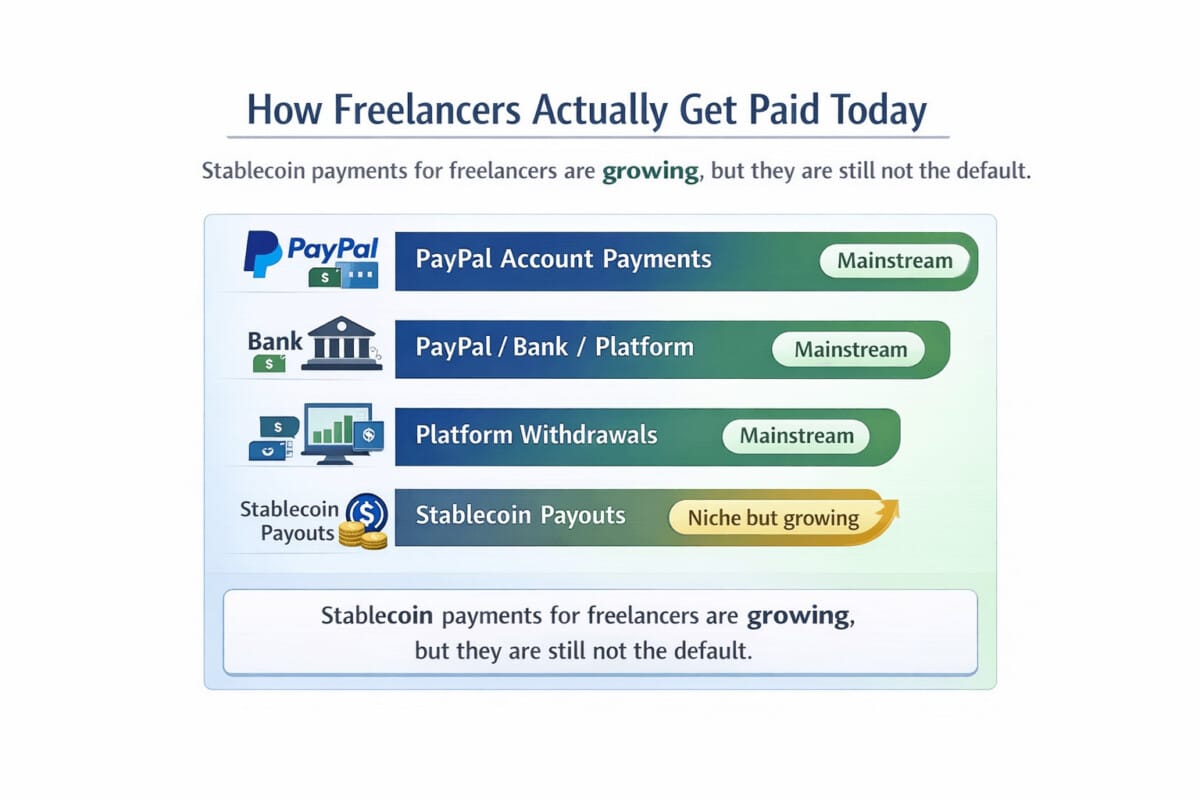
In practice, most freelancer payments still follow a familiar set of rails.
| Payment method | How it is commonly used |
|---|---|
| PayPal account payments | One of the easiest methods for international clients |
| PayPal Payouts | Batch payments for platforms, marketplaces, and businesses |
| Bank transfers | Common for larger invoices and formal B2B arrangements |
| Platform withdrawals | Funds sit inside a platform balance before cash-out |
| Stablecoin payouts | Used by a smaller crypto-friendly segment |
So while stablecoin payments for freelancers is a real trend, it is not the default yet. The center of gravity is still PayPal, banks, and platform-based withdrawals. PayPal remains strong because of its existing distribution, familiar UX, and business payout tools, not just because PYUSD exists.
Why stablecoin payments for freelancers keep getting attention
The answer is not hype. It is friction.
Cross-border payments are still expensive. The World Bank’s Remittance Prices Worldwide data shows that the global average cost of remittances was 6.49% in Q1 2025. Freelancer payments are not identical to remittances, but the broader signal is clear: moving smaller amounts of money across borders is still too costly and inefficient. That ongoing friction is exactly why alternatives keep gaining attention.
This is where stablecoin payments starts to look attractive. Stripe says businesses are using stablecoins to move money faster and more predictably, including payments to contractors and creators. Stripe also highlights use cases such as global payroll, vendor payments, and faster settlement in markets where traditional banking infrastructure is weaker.
That matters for freelancers because the value proposition is easy to understand:
- faster settlement
- more predictable transfers
- lower dependence on legacy banking rails
- easier access to dollar-denominated value in some markets
In other words, the appeal of stablecoin payments for freelancers is not that they sound futuristic. It is that traditional cross-border payments still feel too slow, too fragmented, and too expensive.
Why PYUSD has not changed freelancer payments yet
This is the key point.
For freelancers, the real issue is not whether money can be sent on-chain. The real issue is whether that money can be used easily in daily life.
A freelancer who receives PYUSD still has to ask practical questions:
- Can I cash this out easily in my country?
- Can I use it for rent, taxes, bills, and everyday expenses?
- What happens when I move it outside PayPal?
- Is it really cheaper after all fees are counted?
That last point matters more than many people assume. PayPal’s fee documentation says a 1.5% fee applies when PYUSD is transferred to an external wallet. That means the existence of a stablecoin does not automatically create a lower-cost payout experience.
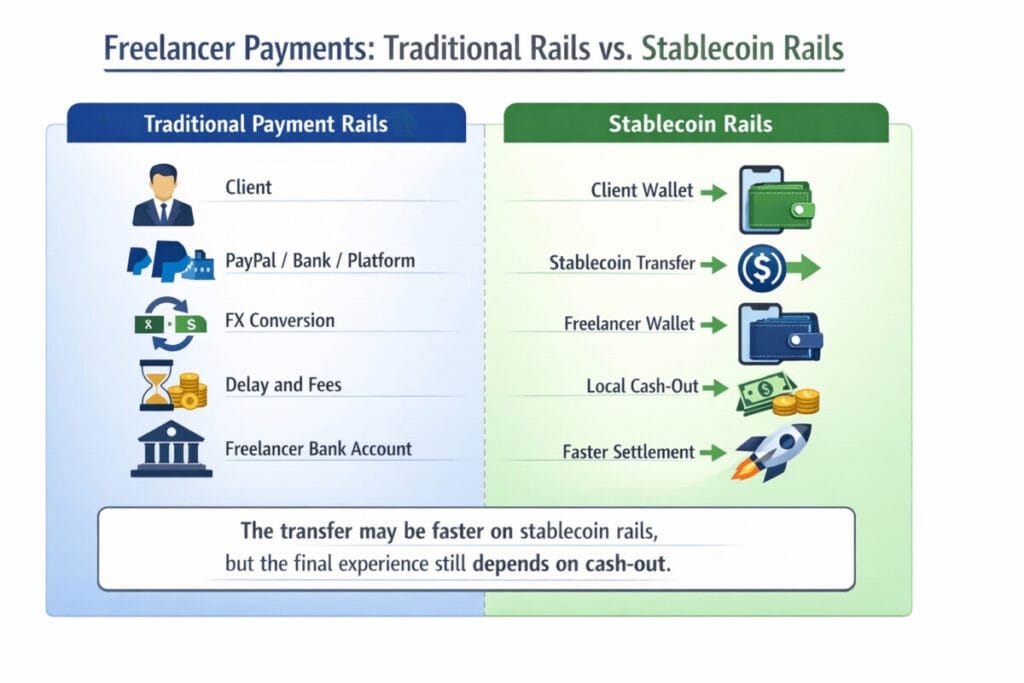
This is why the real battleground for stablecoin payments for freelancers is not transfer speed. It is cash-out.
A faster transfer does not automatically produce a better payout experience if the final step into local currency is still expensive, limited, or inconvenient. Most freelancers still live in a fiat world. Their money eventually has to connect with local bank accounts, cards, bills, taxes, and living expenses.
PYUSD is a signal, but not a complete solution
PYUSD still matters. It shows that PayPal itself does not want to ignore the rise of stablecoins. That is strategically important.
But PYUSD is best understood as a signal, not a final answer.
It suggests that large payment companies see stablecoins as part of the future of digital payments. It does not prove that stablecoins have already become the best practical payout method for most freelancers.
That distinction matters for SEO and for readers. Many people searching stablecoin payments for freelancers are not really asking about crypto. They are asking a simpler question:
Can I get paid faster, lose less to fees, and access my money more easily?
Today, PYUSD only answers part of that question.
What could happen next
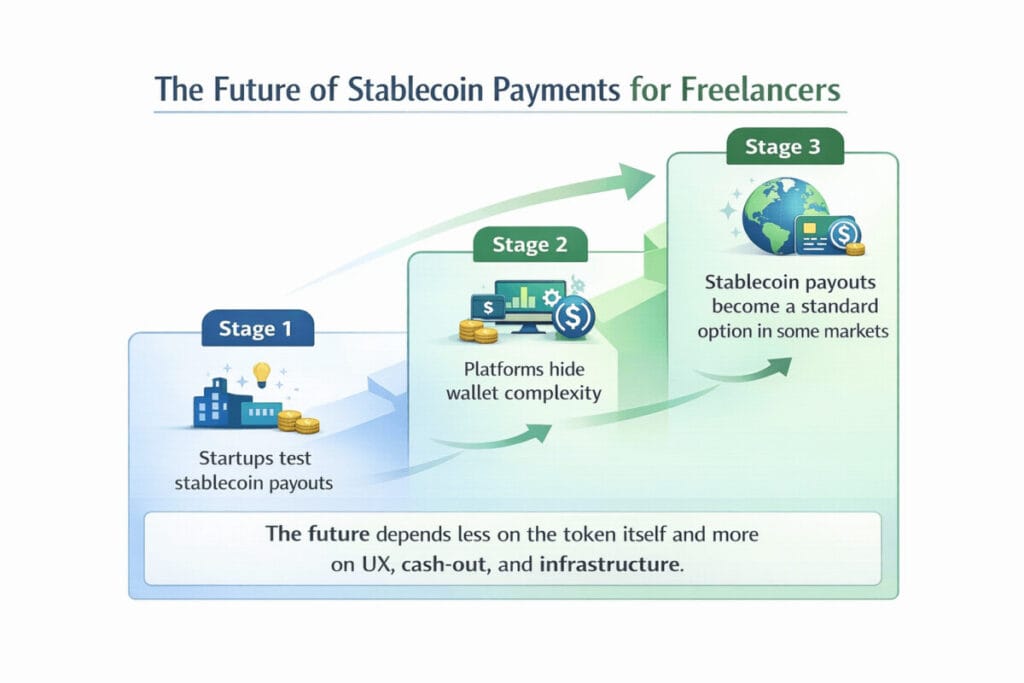
The future of stablecoin payments for freelancers will likely depend less on the token itself and more on the surrounding infrastructure.
The market could evolve in three stages.
| Stage | What changes |
|---|---|
| Stage 1 | More startups and global teams begin testing stablecoin payouts for contractors and freelancers |
| Stage 2 | Platforms hide the wallet and conversion complexity, so users simply feel that they are getting paid faster |
| Stage 3 | In some countries and job categories, stablecoin payouts become a standard option rather than a niche choice |
This future is plausible because the underlying pressures are not going away. Remote work is still globalizing. Businesses still want faster and more predictable payouts. And traditional cross-border payment friction is still very real. Stripe’s recent stablecoin guidance points in that direction, especially for contractor and creator payouts.
The biggest shift will come when freelancers no longer have to think about stablecoins at all.
If the payout experience becomes seamless enough, the user will not say, “I got paid in a stablecoin.” They will say, “I got paid faster.”
That is when stablecoin payments for freelancers could move from niche topic to real payment infrastructure.
Final thoughts
So, has PYUSD replaced PayPal for freelancer payments?
No. Not even close.
But that is the wrong way to frame the story.
The more important truth is this: PayPal having PYUSD confirms that stablecoins are now part of the mainstream payments conversation. Yet freelancer payouts are still shaped by real-world usability, local banking access, FX conversion, tax realities, and cash-out experience.
That is why the most accurate summary is still this:
PayPal has PYUSD, but freelancers still live in a fiat world.
And that is exactly why stablecoin payments for freelancers remains such an important topic to watch.
