
Stablecoin Payments Tracker
Explore how stablecoins are used in real-world payments across remittances, merchant checkout, payroll, business payouts, and treasury flows. This tracker focuses on payment use cases rather than trading activity.
Core payment use cases tracked
Countries and corridors highlighted in this version
Infrastructure players highlighted
Major payment-facing stablecoins compared
Quick answers
If you are new to stablecoin payments, these are the fastest ways to understand what matters.
Cross-border transfers and remittances remain the clearest real-world payment use case.
Business payouts, supplier payments, and treasury movement are where infrastructure is maturing fastest.
Markets with FX friction, high remittance demand, dollar demand, or expensive settlement rails.
This page is not a token ranking page. It focuses on payment function, not speculative trading.
Payment use cases
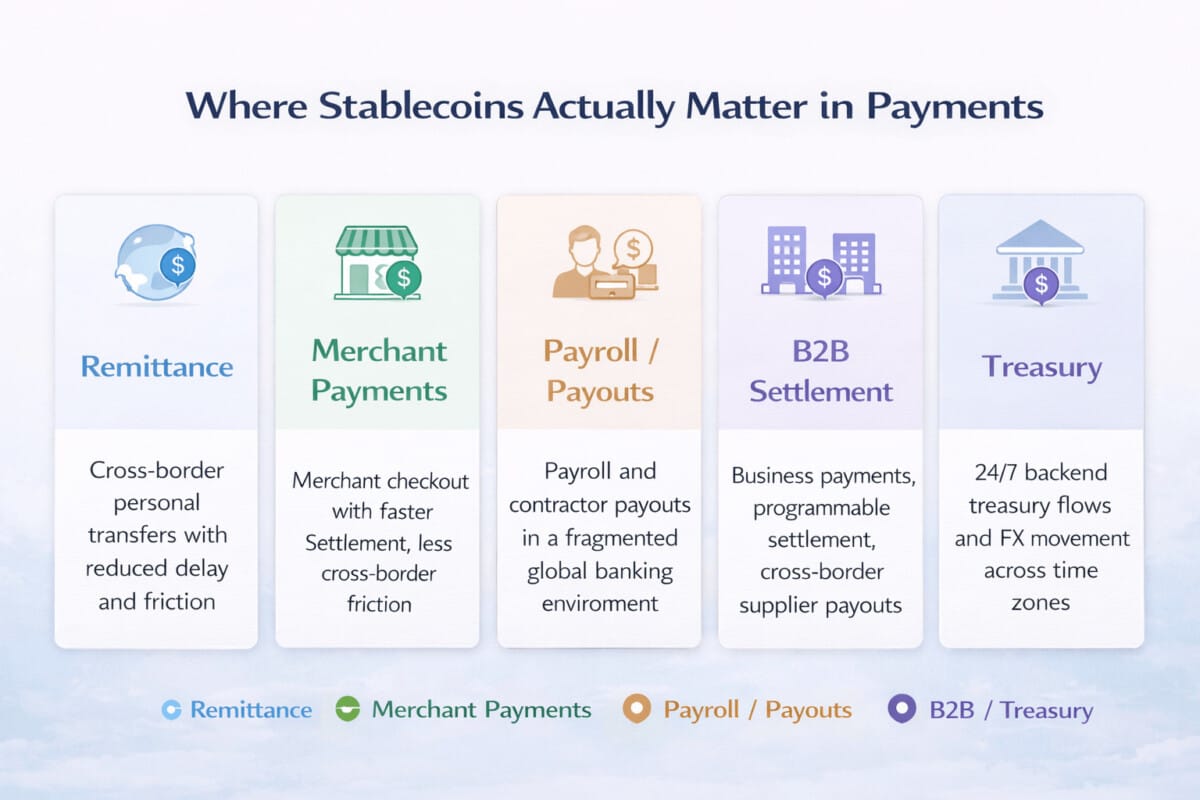
Stablecoin payments are not one single category. The biggest differences come from what problem the payment is trying to solve.
Remittance
Stablecoins can reduce delay and friction in cross-border personal transfers, especially where traditional transfer chains are slow or costly.
consumer
corridor-driven
Merchant payments
Merchant use is still uneven, but the core promise is faster settlement, lower cross-border friction, and digital-native checkout options.
commerce
online-first
Payroll & contractor payouts
Global hiring platforms and crypto-native payout systems use stablecoins where banking rails are slow, expensive, or fragmented.
freelancers
global workforce
B2B settlement
Companies explore stablecoins for supplier payments, cross-border settlement, and programmable business transfers.
settlement
tokenized flows
Treasury flows
This includes internal capital movement, liquidity management, and moving dollar-like value across markets and time zones.
24/7 movement
backend use
Infrastructure-linked card spending
In some cases, stablecoins are not spent directly. They are bridged into card or wallet experiences that hide the crypto layer from users.
wallet layer
consumer abstraction
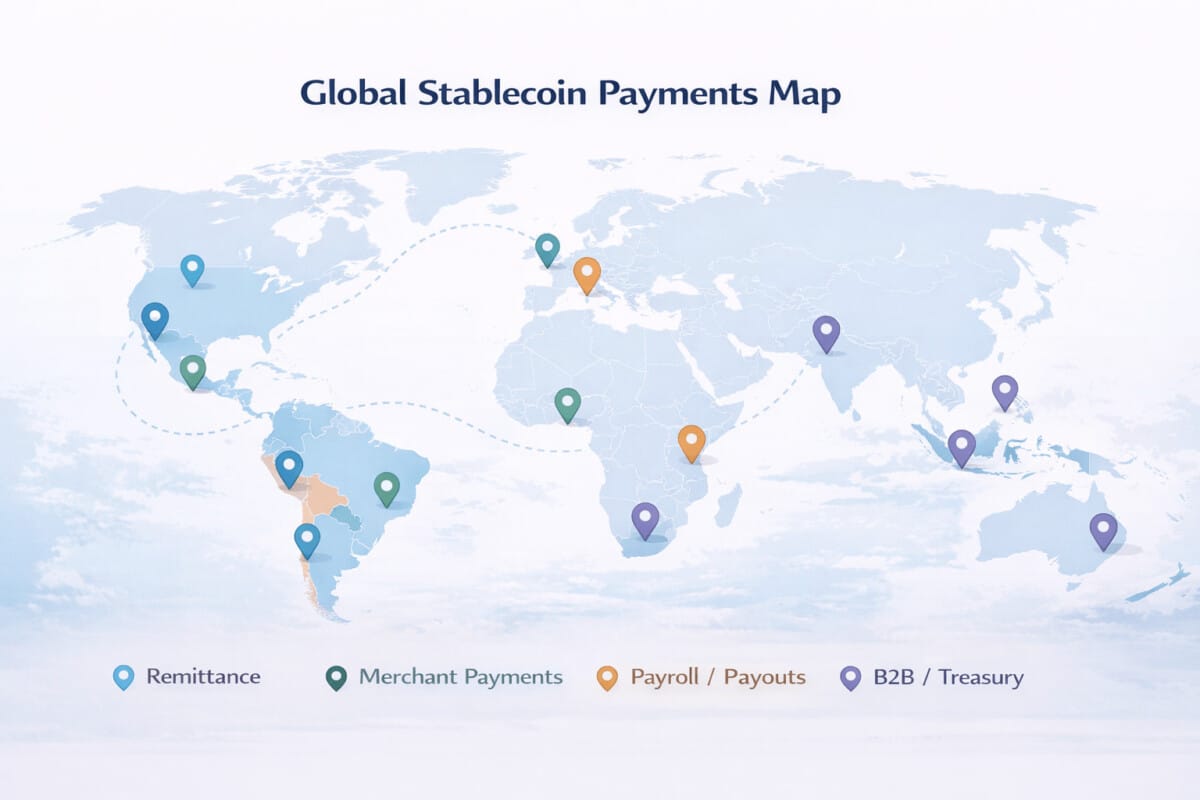
Country and corridor tracker
Users usually want to know where stablecoin payments matter most. The table below focuses on payment need, not general crypto interest.
| Country / Corridor | Main use case | Why stablecoins matter | Typical asset | Status |
|---|---|---|---|---|
|
Philippines remittance and exporter / SME liquidity angle | Remittance / business transfers | Cross-border flows and time-sensitive access to funds matter more than pure speculation. | USDT / USDC | Live use case |
|
Latin America regional cross-border and business remittance relevance | Cross-border payments / remittance | Dollar access, regional payments, and faster settlement are recurring themes. | USDC / USDT | Live use case |
|
Africa corridors business and payment utility focus | Business transfers / settlement | Stablecoins can help where correspondent banking access and FX friction remain difficult. | USDT / USDC | Limited rollout |
|
Argentina dollar demand and digital payments relevance | Savings-linked payments / transfers | Dollar-linked digital value can matter in volatile local currency environments. | USDT | Demand-driven use |
|
Nigeria cross-border and FX friction relevance | Transfers / business payments | Stablecoins are often discussed where international value movement is costly or constrained. | USDT | Active but uneven |
|
UAE international business and settlement relevance | B2B / treasury / settlement | Global business flows and digital asset infrastructure create a natural backend payments use case. | USDC | Infrastructure buildout |
|
United States platform and infrastructure layer more than one domestic use case | Merchant integration / settlement / wallet ecosystems | The US matters because many major infrastructure players are based there. | USDC / PYUSD | Mixed maturity |
|
Singapore regional infrastructure and settlement relevance | Infrastructure / cross-border experimentation | Important as a regional digital finance hub rather than a mass retail stablecoin checkout market. | USDC | Infrastructure-led |
Infrastructure layer
Stablecoin payments depend on processors, wallets, rails, payout providers, exchanges, and treasury infrastructure. This is where the real payment stack becomes visible.
Stripe
Best understood as a payment processor layer exploring how stablecoins fit into merchant payments, subscriptions, and international payment flows.
subscriptions
payments API
Visa
Important more as infrastructure than as a wallet. The payment story here is settlement, payouts, and bridging stablecoins into existing payment networks.
payouts
card bridge
Circle
Often positioned around business payments, treasury flows, supplier payouts, and programmable dollar movement rather than just consumer checkout.
business payments
treasury
PayPal
PYUSD gives PayPal a direct role in consumer-facing stablecoin payments, though its strongest payment relevance may still depend on ecosystem adoption.
wallet ecosystem
consumer layer
Coins.ph
Useful as a real-world reference point where stablecoins are discussed in relation to remittance, SME payments, and exporter cash flow.
remittance
SME flows
Bitso Business
One of the clearest examples of stablecoin-linked business remittance and regional cross-border payment infrastructure in Latin America.
B2B remittance
regional rails
Stablecoins used in payments
This tracker compares stablecoins by payment role, not by speculation or price performance.
| Stablecoin | Main payment fit | Where it appears most | Strength | Limitation |
|---|---|---|---|---|
| USDT | Transfers / remittance / liquidity-heavy corridors | Emerging-market flows, exchange-linked payment movement | Broad liquidity and familiarity | May be less favored in some compliance-sensitive enterprise contexts |
| USDC | Business payments / settlement / infrastructure integrations | Fintech platforms, treasury, enterprise payment rails | Strong fit for infrastructure and programmable payments | Consumer mindshare can be lower than broader-market transfer assets |
| PYUSD | Wallet-linked commerce and ecosystem payments | PayPal-linked use cases and digital commerce narratives | Potentially strong consumer bridge if ecosystem use expands | Still narrower in visible payment footprint than older major stablecoins |
What this tracker measures
It measures payment relevance: use cases, infrastructure roles, corridor demand, and rollout status.
What this tracker does not measure
It does not rank tokens by market hype, speculative trading, or short-term price moves.
How to read “status” labels
Live means visible real-world usage. Limited rollout means active but uneven use. Pilot means testing. Infrastructure-led means backend relevance is stronger than consumer adoption.
What to watch next
Watch merchant acceptance, stablecoin-linked payouts, on/off-ramp quality, regulation, and whether backend settlement expands faster than direct consumer checkout.